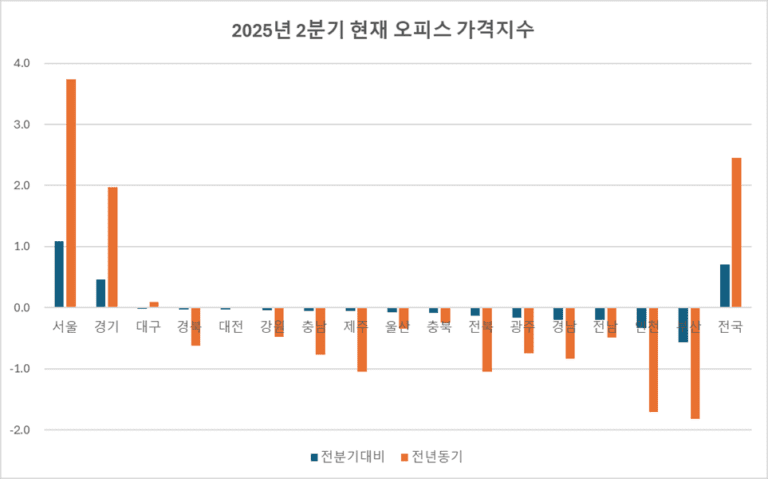
The national office rental price index for the second quarter of 2025 rose 0.71 tpa3t (total 300,000 units) compared to the previous quarter and 2.41 tpa3t (total 300,000 units) compared to the same period last year. However, regional trends differed significantly. While the Seoul metropolitan area led the upward trend, some major regional cities were unable to avoid declines.
Source: Ministry of Land, Infrastructure and Transport, Commercial Real Estate Lease Trends Survey Data
Seoul showed the most significant increase, up 1.11 TP3T quarter-on-quarter and 3.71 TP3T year-on-year. Gyeonggi Province also saw a 0.51 TP3T quarter-on-quarter and 2.01 TP3T year-on-year increase, supporting the overall recovery trend in the metropolitan area. The metropolitan area, home to a high concentration of high-value-added service industries such as IT, finance, consulting, and biotechnology, is experiencing steady demand for office space. However, land restrictions and regulations limit new supply, continuing to pressure upward rents.
Meanwhile, regional metropolitan cities recorded a decline due to oversupply and limitations in their industrial structures. Busan saw a decrease of -0.61 TP3T in the previous quarter, down -1.81 TP3T year-on-year. The large-scale supply of new office space in recent years has led to a short-term oversupply. Despite the recovery in the shipping and shipbuilding industries, this has been limited to production and logistics-focused industries, failing to translate into office rental demand. Incheon also saw a decrease of -0.31 TP3T in the previous quarter, down -1.71 TP3T year-on-year. This was due to the increased occupancy of new buildings in Songdo and Cheongna International Cities, which led to a rise in vacancy rates, and the concentration of demand from the port and logistics industries in logistics centers and warehouses. Gwangju saw a decrease of -0.21 TP3T in the previous quarter, down -0.81 TP3T year-on-year. This is attributed to a weak manufacturing and service industry base and continued population outflow, which has hindered the pace of attracting new businesses. Ulsan saw a decrease of -0.11 TP3T in the previous quarter, down -0.31 TP3T year-on-year. Despite the gradual recovery of the shipbuilding and petrochemical industries, the industrial structure's focus on production and exports limits the expansion of office demand. North Jeolla Province (-1.11 tp3t) and Jeju Island (-1.01 tp3t) also showed declines due to a combination of factors, including their industrial base, population structure, and supply conditions.
The outlook for the second half of the year is highly likely to see further widening regional disparities. Visa-free entry for Chinese nationals and the recovery in global tourism are expected to have a positive impact on commercial districts in the Seoul metropolitan area and some metropolitan cities. In particular, the potential for increased domestic investment by Chinese companies could stimulate demand for office space in urban areas. Conversely, regions that have failed to diversify their industrial structures and continue to experience oversupply are expected to struggle to recover in the short term.
Source: Ministry of Land, Infrastructure and Transport, Commercial Real Estate Lease Trends Survey Data
Office vacancy rates remain flat nationwide, with South Chungcheong and Busan recovering, while Ulsan and Gyeonggi Province see increases.
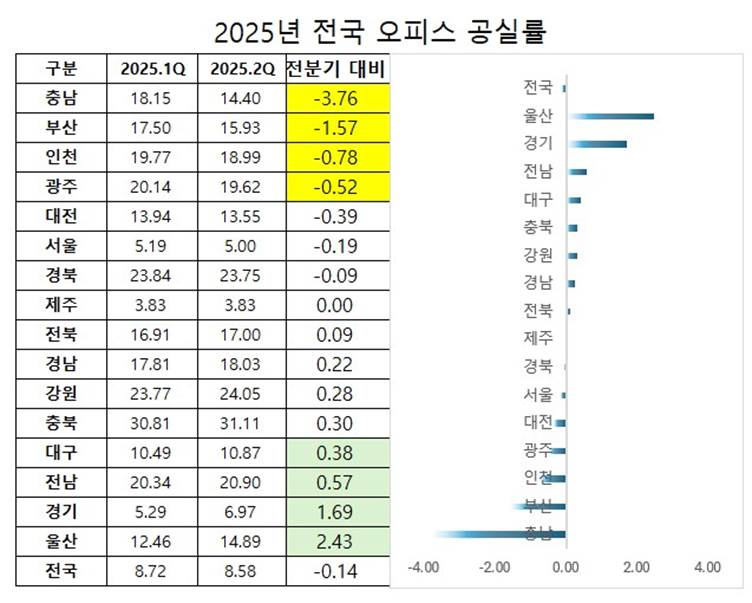
The national office vacancy rate for the second quarter of 2025 was recorded at 8.581 tp3t. This was a 0.141 tp3t decrease from the previous quarter (8.721 tp3t), maintaining the national average at a flat level. However, regional trends varied, with recovery and deterioration both occurring in different regions.
South Chungcheong Province recorded the largest decline nationwide, dropping 3.761 tpp3t points from 18.151 tpp3t to 14.401 tpp3t. This decline is attributed to the expansion of businesses in the Cheonan-Asan industrial belt, startup support policies, and more realistic rents. Busan saw a 1.571 tpp3t point decrease, from 17.501 tpp3t to 15.931 tpp3t. This decline is attributed to the revitalized corporate demand, driven by expectations of positive development prospects such as the relocation of the Ministry of Oceans and Fisheries, the redevelopment of the North Port, and the revitalization of the International Passenger Terminal. Demand from ports and logistics infrastructure and demand surrounding universities also contributed to the vacancy reduction.
Incheon saw a 0.781 TP3T decrease, from 19.771 TP3T to 18.991 TP3T. This gradual decline continued due to steady demand from Songdo International City's business and bio industries and the Cheongna and Yeongjong areas' airport and port connections. Gwangju saw a 0.521 TP3T decrease, from 20.141 TP3T to 19.621 TP3T. Urban regeneration projects, expansion of multi-cultural facilities, and expansion of youth entrepreneurship support centers and shared office spaces appear to have driven demand for new businesses.
Daejeon's market share fell by 0.391 TP3T points, from 13.941 TP3T to 13.551 TP3T. This is interpreted as a result of the connection between the Daedeok Research Complex, the administrative town, and Sejong City, which supported office demand. Seoul maintained a stable level at 5.001 TP3T, and Gyeongbuk Province saw a slight decline to 23.751 TP3T, but still maintained a high level.
Ulsan, Gyeonggi, Jeonnam, and Daegu are facing increasing vacancy rates, increasing the burden on the housing market.
Ulsan saw the largest increase nationwide, rising by 2.431 TP3T points from 12.461 TP3T to 14.891 TP3T. Despite the recovery of the shipbuilding and automobile industries, demand was not sufficiently supported by new office supply and a declining population.
The market rose 1.691 tp3t from 5.291 tp3t to 6.971 tp3t. The short-term increase in vacancy appears to have been driven by a surge in office space in new cities like Dongtan, Wirye, and Gwanggyo. The economic downturn, which has dampened demand for new office space from companies, also contributed. However, the vacancy rate itself remains low nationwide, leading some to speculate that this is due to a temporary oversupply.
South Jeolla Province saw a 0.571 TP3T increase, from 20.341 TP3T to 20.901 TP3T. While supply continued in the Gwangyang-Yeosu industrial complex, Naju Innovation City, and the Mokpo Port hinterland, population outflow and an aging population weakened the demand base, leading to worsening vacancy rates.
Daegu saw a 0.381 TP3T increase, from 10.491 TP3T to 10.871 TP3T. While the vacancy rate itself is only slightly higher than the national average, it appears that unsold apartments, an exodus of young people, and urban redevelopment have not fully absorbed office space. North Chungcheong Province recorded the highest vacancy rate in the country at 31.111 TP3T, while Gangwon Province also maintained a high rate at 24.051 TP3T.
Office vacancy rates are a barometer of corporate demand.
The office vacancy rate isn't simply the percentage of empty offices; it's used as an indicator of corporate activity and the local economic foundation. A low vacancy rate signifies robust corporate demand and a stable local economy. Conversely, a high vacancy rate reveals structural problems such as oversupply, population decline, and shrinking investment. Therefore, the vacancy rate serves as a crucial reference point for market participants, including landlords, investors, and corporate buyers, when assessing trends.
REMAX Korea plans to continuously monitor the commercial real estate market and release helpful data for market understanding. REMAX is a global real estate franchise brand with a network of over 140,000 agents in over 110 countries. REMAX Korea provides customized consulting services in the domestic office and commercial real estate markets, leveraging its professional network and data.