Housing prices in the Seoul metropolitan area have been skyrocketing for quite some time, making it increasingly difficult for newlyweds to begin their married life without financial support from their parents. While there was a time when newlyweds could start their lives in a single-room apartment and gradually expand their nest egg, today's younger generation no longer takes such a start for granted. With rising housing costs and changing lifestyle standards and values, the "single-room honeymoon" is becoming less romantic and more a reality.
In this reality, there's a growing number of newlyweds starting their new lives by renting a home in their parents' name for free or renting it for much less than the market price. While this may seem like a reasonable gesture for wealthy parents to offer their children, tax law presents a different challenge. Free or low-cost rentals can be considered gifts, potentially resulting in tax implications.
In this article, we will examine the gift tax issues that arise from this type of housing.
1. When parents rent a house to their children free of charge
If a benefit is derived from the gratuitous use of another's real estate, the date on which such gratuitous use commenced is deemed the date of gift, and gift tax is levied on the amount equivalent to the benefit. (Article 37 of the Gift and Gift Act) Meanwhile, the equivalent amount of benefit from gratuitous use of real estate is subject to gift tax in a lump sum calculated by converting the equivalent of five years' worth of rent into present value using the formula below. However, if the amount is less than KRW 100 million, no tax is imposed. (If the gratuitous use period exceeds five years, the gratuitous use of the real estate is deemed to have commenced anew on the day following the fifth anniversary of the date on which such gratuitous use commenced.)
- Profit from free use of real estate = real estate value * 2% * 3.7907 (5-year annuity present value coefficient)
In other words, if the market price of the real estate is less than approximately 1.3 billion won, the profit from the gratuitous use of the real estate is less than 100 million won, so gift tax is not imposed. However, if the market price exceeds approximately 1.3 billion won, gift tax is imposed on the profit from the gratuitous use. However, even if the market price exceeds 1.3 billion won, if the person resides with their parents, who are the owners of the real estate, gift tax on the gratuitous use may not be imposed.
2. When parents rent a house to their children at a price lower than the market price.
So, what if you received a small deposit or monthly rent from your child? If you receive rent that's lower than the market rate, gift tax is levied annually on the difference between the fair rent and the actual rent paid, according to Article 42 of the Gift Tax Act. However, this tax is only levied if the difference exceeds 30% of the fair rent. Therefore, if your child pays their parents more than 70% of the fair rent, gift tax does not arise.
A reasonable rent is generally defined as the standard payment between an unspecified number of people. In cases where this is unclear, the fair rent is considered to be 2% of the market price of the property. If a rental deposit is collected as all or part of the consideration, the rent is deemed to be collected at the interest rate determined by the Ministry of Strategy and Finance (the interest rate on time deposits, 3.1% as of 2025). Let's examine this with a simple example.
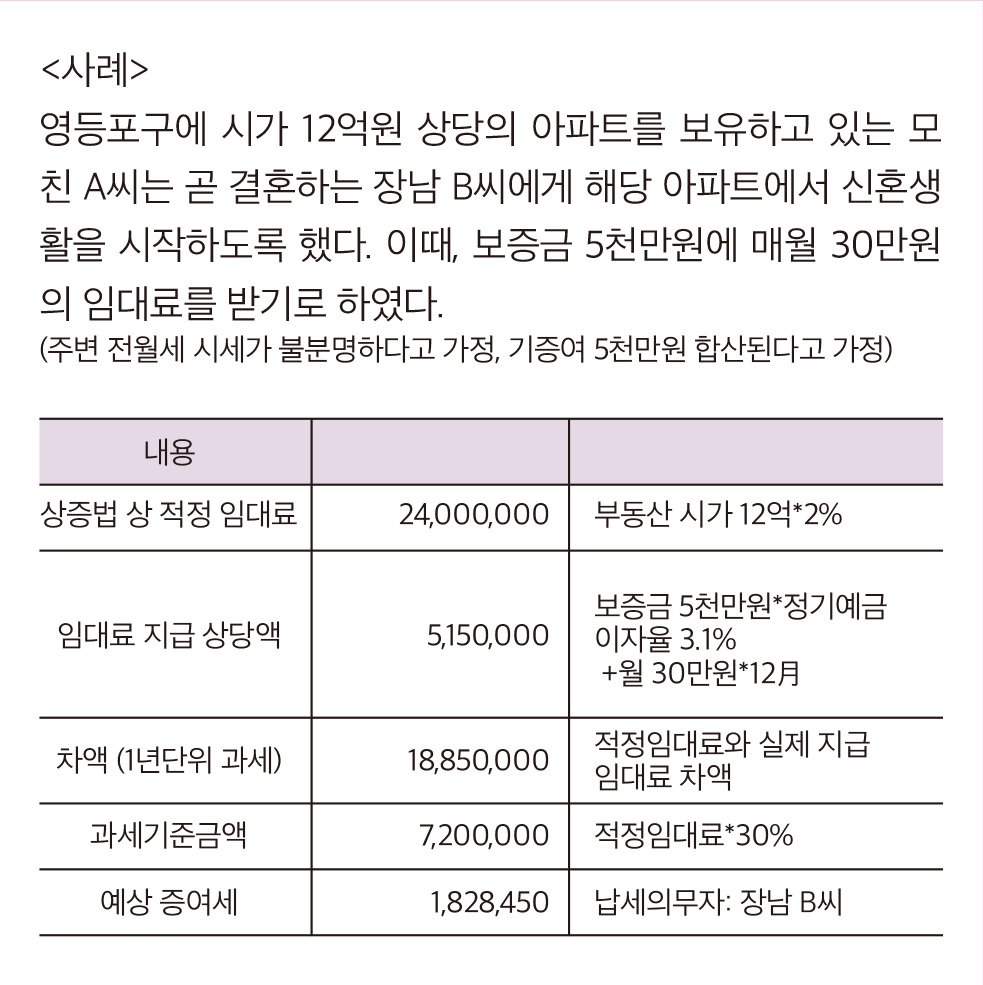
As mentioned earlier, gift tax issues arising from low-cost rentals arise annually and are calculated by adding the gift amount from the 10 years prior to the gift date to a progressive tax rate. Consequently, the annual gift tax burden will increase over time. A situation where a 1.2 billion won home leased free of charge would have avoided any gift tax burden could arise, where even a portion of the rent is received, resulting in a gift tax burden. Therefore, such transaction structures require thorough pre-evaluation.
Free or low-cost real estate rentals between parents and children are common family support, so they're often overlooked. However, overlooking them often leads to unexpected gift tax burdens. While this article focused on residential properties, the implications for commercial properties, such as non-residential properties, can be even more complex, with income tax and value-added tax implications. To avoid unnecessary tax burdens, it's advisable to consult with a professional in advance to assess potential tax risks.

As the representative tax accountant of Namjeong Tax Accounting, he specializes in property taxes related to transfers, inheritances, and gifts, as well as business succession consulting and tax diagnosis. Drawing on extensive consulting and tax-saving planning experience, he demystifies complex tax laws and offers practical solutions that combine practicality and legal principles. His writing goes beyond simply addressing tax issues, exploring sustainable wealth management and the future of business.
Tax Accounting Namjeong, 106 Gukjegeumyung-ro, Yeongdeungpo-gu, Seoul, Room 318 (010-8639-7620)