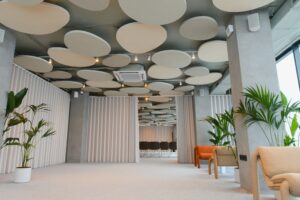
Hospital inpatient facilities are crucial spaces that provide convenience to medical staff, patients, and visitors. Consequently, many people seek to lease space within these facilities to start businesses. But if they want to open a cafe, convenience store, or restaurant there, will they be protected by the Commercial Building Lease Protection Act (hereinafter referred to as the Commercial Lease Act)? While hospital buildings might seem far removed from commercial properties, the actual application of the law is not so straightforward. Today, we'll delve deeper into this issue.
What does the Commercial Lease Act protect?
The Commercial Lease Act is a special law enacted to protect small business owners. Key to its application are the primary use of the leased property for commercial purposes, and the tenant must be able to register a business in the building. In other words, simply having a building that resembles a commercial building or that engages in some commercial activity is not sufficient. Commercial activity must be the core activity, generating revenue.
Of course, no matter how high the deposit, key provisions such as tenants' right to object, the right to request a contract renewal, and protection of the opportunity to recover key money still apply. However, temporary leases are not protected by this law.
The Importance of "For-Profit" as Spoken in Case Law
To help you understand, let's look at some actual court decisions.
The Busan District Court ruled that the Commercial Lease Act did not apply to a non-profit organization for the purpose of rehabilitation of persons with disabilities that leased a building for office purposes. Even though the organization was registered as a business, its primary purpose was not for profit. This demonstrates how the actual purpose of use is more important than the superficial business registration.
In contrast, the Seoul Central District Court ruled that the Commercial Lease Act applied to a case where a convenience store was operated by leasing part of the first floor of a hospital building. While a hospital is a special building, if a convenience store is operated within it for profit, the tenant should be protected. This suggests that the commercial use of individual leased spaces, rather than the overall purpose of the building, is the key to applying the law.
How should we consider leasing a hospital welfare center?
Now, let's return to our current case, the lease of a hospital welfare center building. Whether the Commercial Lease Act applies depends on the purpose of leasing the space within the welfare center.
1. Cases eligible for protection under the Commercial Lease Act
If you plan to operate a commercial facility within a hospital for profit, such as a cafe, restaurant, convenience store, pharmacy, bakery, or beauty salon, there's a high chance it will be protected by the Commercial Lease Act. The key here is that the space must be eligible for business registration and must actually be registered. Despite the unique nature of a hospital, any commercial activity intended for profit is protected within the legal framework.
2. Cases where application of the Commercial Lease Act may be difficult
Conversely, if the purpose of the lease is far from commercial activity (e.g., a simple break space for hospital staff, an office for a non-profit organization, a volunteer activity space, etc.) or if the space itself is ineligible for business registration, the Commercial Lease Act may not apply. The key question is whether the primary purpose is "business activities to make money."
Careful checking before signing a contract is essential!
Whether the Commercial Lease Act applies to the lease of a hospital's welfare center building ultimately depends on the purpose of the lease. If the business intends to generate revenue through commercial operations and the space meets business registration requirements, the law provides adequate protection.
Therefore, before entering into a lease, don't be confined to simply thinking of it as a "hospital building." Carefully consider the specific intended use of the leased space, whether it's eligible for business registration, and the actual business activities you intend to conduct. Furthermore, when drafting a lease with the landlord, meticulous preparation is essential to avoid legal disputes, such as clearly stating the purpose of the lease as "business use."
While the law may seem complex, it also serves as a safeguard to protect your valuable business. If you encounter any ambiguities, always consult a legal professional for clear answers and to ensure a safe and secure business.

Attorney Sunjin Kim has been mediating franchise disputes based on coexistence for the past 10 years and is working to restore the franchise to its original state. KLF handles nearly 100 franchise lawsuits every year and is Korea's top franchise-specialized law firm that serves as an advisor to several franchise companies.
KLF Franchise Law Firm Room 205, 2nd floor, 151 Seochojungang-ro, Seocho-gu, Seoul 02-738-9600