
When an individual acquires a commercial or office building through a sale, the acquisition tax is, in principle, 41 TP3T (4.61 TP3T including the Local Education Tax and Special Tax for Rural Development). However, the moment the same building is purchased in the name of a corporation, the tax rate jumps to 81 TP3T, and in some cases, even up to 121 TP3T. Heavy taxes are not automatically imposed simply because the entity is a corporation. This is because it falls under certain "conditions for heavy taxation" stipulated in Articles 13 and 13-2 of the Local Tax Act.
The Root of Heavy Pay — Suppressing Population and Industrial Concentration in the Capital Region
The starting point for the heavy corporate acquisition tax is the "Overcrowding Control Zone" under the Capital Region Planning Act. This applies to key areas of the capital region, including all of Seoul, most of Incheon, and Uijeongbu, Guri, Hanam, Goyang, Suwon, Seongnam, Anyang, Bucheon, Gwangmyeong, Gwacheon, Gunpo, and Siheung (with some exceptions). To prevent companies from flocking to these areas, a system was established to impose heavy acquisition taxes when corporations acquire real estate in these locations, thereby curbing population growth. Therefore, in principle, this type of heavy taxation is not an issue when a corporation acquires a building located in a provincial area.
Summary by Type of Middle School
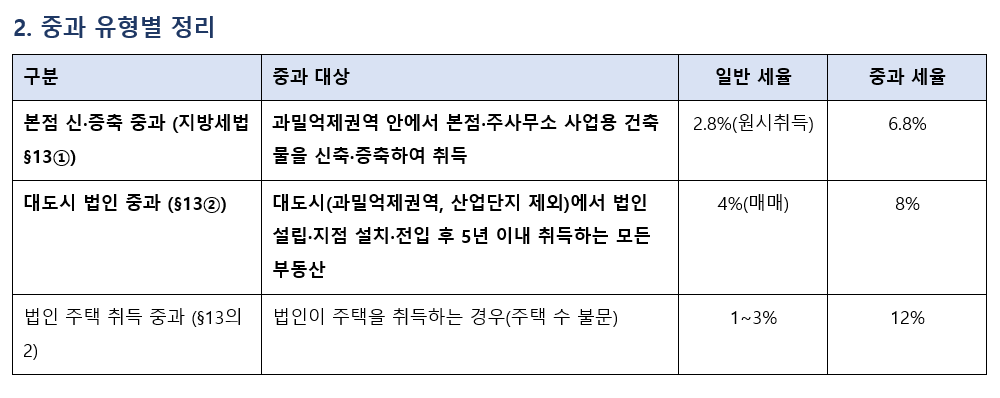
① Increased tax on the new construction or expansion of a business building for a head office (Article 13, Paragraph 1). If a corporation directly constructs or expands a building to be used as its head office or principal office within an overcrowded area, twice the standard tax rate is added to the increased tax rate (2%).
The standard acquisition tax rate of 2.81 TP3T is increased by 41 TP3T, resulting in 6.81 TP3T. To avoid this, it is necessary to determine the corporation's business type and prove that the property is not used for the head office's primary business. In practice, methods for leasing are sometimes employed, but there are frequent cases where acquisition tax is levied if the property is used for the intended purpose of the head office within a few years.
② Increased taxation on acquisitions made within 5 years of establishing or relocating a corporation within a large city (Article 13, Paragraph 2). This is the provision that is most frequently problematic in practice. When a corporation is established or a branch is set up in a large city, or when a corporation outside a large city moves its head office or branch to a large city, the rate applied to real estate acquired within the large city within 5 years from that date is “Standard tax rate × 3 − Increased tax base rate × 2”.

If acquired through sale, the calculation is 4% × 3 − 4% = 8%, which is exactly double the general tax rate. This applies regardless of whether the property is an office, commercial building, warehouse, or land, and does not matter whether it is for business or rental purposes. Acquiring and utilizing a dormant corporation is also considered an establishment. However, if acquired for the purpose of direct use in "industries exempt from heavy taxation"—such as banking, medical services, private academies, and telecommunications businesses—which are recognized as unavoidable to be located in major cities, the general tax rate applies.
③ Heavy taxation on housing acquisition by corporations (Article 13-2). If a corporation acquires housing after August 2020, the 12% rate applies in principle, regardless of the number of houses owned. Since this tax rate applies to the housing portion when a corporation purchases a commercial-residential building or a residential officetel, it must be verified in advance.
Duplicate Application and Points to Note
- Overlapping application: Since ① and ② are separate regulations, if they apply simultaneously, the tax rate becomes higher (if the newly expanded head office building is acquired within 5 years of establishment, the standard tax rate × 3 = 8.41 TP3T). If luxury property and the metropolitan heavy tax overlap, it can reach 161 TP3T.
- Calculation of the 5-year period: The standard is the date of registration of incorporation, the date of establishment of the branch, or the date of relocation. Even if the business moves from another area within the densely populated zone to Seoul, a new 5-year period begins. The key factor is whether the date of final payment (acquisition date), not the contract date, falls within the 5-year period.
- Post-acquisition: If acquired as an industry exempt from heavy taxation and then converted to another use within 2 years (unused without justifiable reason) or 4 years, it will be subject to heavy taxation at the heavy tax rate.

Ultimately, determining whether a heavy taxation applies to the acquisition of a building in a corporate name boils down to three questions: “Where is the building located?”, “When and where was the corporation established and registered?”, and “What is the building intended for?” Simply verifying these three points before signing the contract can reduce the acquisition tax burden by half or, at the very least, help you avoid unexpected tax bills.
Tax rates and application requirements are revised annually, and since it is difficult to modify the contract after the final payment and registration, you must consult with an expert immediately after signing the contract to determine whether heavy acquisition tax will apply before proceeding with the final payment and acquisition registration.