Structural Changes in the Commercial Market as Seen Through Vacancy Rate Statistics
The trend of increasing vacant commercial properties continues, particularly in major downtown commercial districts and new towns in the metropolitan area. Even in areas with favorable locations, many commercial properties are struggling to find tenants, yet rents often remain largely unchanged. This contradictory phenomenon of rising vacancy rates and rigid rents has become a structural characteristic of the recent commercial real estate market.

The reason tenants commonly cite on-site isn't simply "I don't think business will work out." Even if a certain level of foot traffic and sales are expected, considering rent, labor, and fixed costs, the business structure is deemed unviable, leading to contract cancellations. Especially in central commercial districts, many respond that the burden of rent puts a strain on profitability.
In fact, some self-employed restaurant owners who operated restaurants near major business districts in the metropolitan area are closing their businesses, citing rent burdens separate from sales, and are either putting off reopening or choosing other forms of business. This is interpreted as a case of cost structures reaching their limits, rather than a problem with the commercial district.
Vacancy rates in mid- to large-scale commercial buildings and multi-storey buildings are rising nationwide.
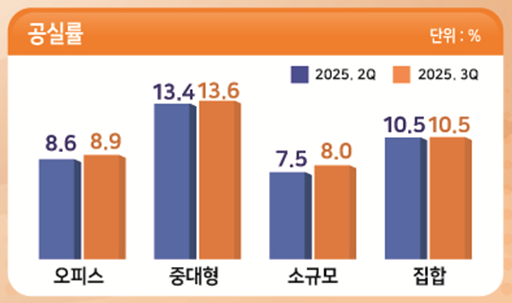
This trend is confirmed by statistics. According to the 2025 Q3 Commercial Real Estate Lease Trends Survey released by the Korea Real Estate Board, the average vacancy rate for commercial complexes nationwide was 10.51 tp3t. Small-scale commercial buildings recorded 8.01 tp3t, while medium- to large-scale commercial buildings recorded 13.61 tp3t. This indicates that the larger the commercial building, the greater the burden of vacancy.
Regional differences are also evident. Ulsan recorded the highest vacancy rate in the nation at 20.51 tp3t for multi-storey buildings. While the national average for mid- to large-sized commercial buildings is 13.61 tp3t, even Seoul, considered to have the most stable commercial real estate demand, saw its vacancy rate rise to 8.91 tp3t. This demonstrates the accumulating burden of vacancy even in key commercial districts.
This suggests that the commercial vacancy problem is not limited to certain regions or specific commercial districts, but rather is structurally widespread nationwide. Analysts suggest that this is the result of a complex interplay of supply structure, changes in consumption patterns, and cost structures, rather than a short-term economic adjustment.
Why Rents Don't Fall: The Impact of Asset Values and Institutions

The reason rents remain difficult to adjust despite rising vacancy rates lies in the pricing structure of commercial real estate. Commercial properties are often valued based on rental income, so rent reductions can directly lead to a decline in asset value. Consequently, landlords prioritize maintaining asset value over short-term vacancy losses.
Here, contract structures and institutional factors also reinforce rent rigidity. There's a strong perception that once rents are lowered, they are difficult to recover even if the market recovers. Considering contract terms and restrictions on increases, rent reductions are expected to be a long-term burden. However, experts say that this 'holding out strategy' is not always a rational choice.
Mr. A, a commercial real estate consulting expert, explained, “The choice to give up a significant amount of rental income every month to maintain rent may seem like a strategy to preserve asset value in the short term.” He added, “If vacancy continues for a long time, the accumulated financial costs, management costs, and opportunity losses due to tying up funds can act as a burden on the actual asset value.”
Another real estate investment analyst said, "If the market environment has changed from the past, rental strategies also need to be adjusted accordingly." Rather than unconditionally holding on, realistic responses such as restructuring rental rates, switching industries, and making contracts more flexible may be more effective for long-term asset management.
Maintaining vacancy or cutting losses should be judged based on long-term cash flow.

Experts point out that deciding whether to keep a commercial property vacant or sell shouldn't be based solely on short-term monthly profits and losses. While maintaining rents while vacant might seem like a strategy to protect asset value, if vacancy persists for years, the financial costs, property tax burden, and opportunity costs associated with tying up funds must also be considered.
Especially when the same funds can be reinvested in more competitive locations or assets with more stable earnings structures, a simple "hold on" strategy is not necessarily the best option. Analysts suggest that maintaining vacancy, adjusting rents, and even cutting losses should ultimately be judged based on long-term cash flow and asset management efficiency.
Commercial properties are not simply objects of monthly rent; they are assets constantly being re-evaluated amidst market conditions, consumer trends, and capital movements. The current commercial market demands more sophisticated criteria for judgment, facing the question of "hold on or close?"