
2025.10 complex housing price index
[Trading]
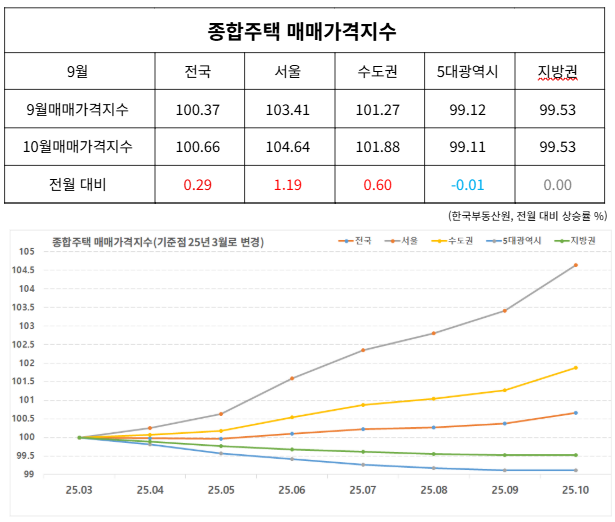
The national housing price index rose 0.291 TP3T in October 2025 compared to the previous month, continuing its upward trend for seven consecutive months. Seoul, in particular, saw a 1.191 TP3T increase, significantly exceeding the national average. The strong rebound was concentrated in key areas with excellent residential conditions, education, and transportation infrastructure. Seongdong-gu (+3.011 TP3T), Songpa-gu (+2.931 TP3T), Gangdong-gu (+2.281 TP3T), and Mapo-gu (+2.211 TP3T) saw significant increases. This increase appears to have been driven primarily by a surge in demand in areas that were not designated as land transaction permit zones prior to the October 15th measures.
The Seoul metropolitan area saw a larger increase, with a 0.601 TP3T increase. In Incheon, the largest increases were recorded in Seo-gu (+0.131 TP3T) and Dong-gu (+0.111 TP3T). In the Gyeonggi region, notable increases were observed in Bundang-gu, Seongnam (+4.041 TP3T) and Gwacheon (+3.041 TP3T). This increase appears to have been primarily due to the surge in demand prior to the October 15th measures. Gwangmyeong (+1.751 TP3T) and Hanam (+1.611 TP3T) also showed notable increases compared to the previous period.
Meanwhile, among the five metropolitan cities, Daegu (-0.13%) saw a decline, led by small and medium-sized businesses in Dalseo-gu and Buk-gu. Daejeon (0.10%) saw a decline, led by Jung-gu and Yuseong-gu. Among other regions, Jeju (-0.14%) saw the highest decline, but Jeollabuk-do (0.15%) saw a rise, leading to a flat finish.
[charter]

The national rental price index in October 2025 rose 0.18% from the previous month, recording a gradual increase for five consecutive months. Seoul saw a 0.431 TP3T increase, exceeding the national average. This significant increase was driven by continued rental demand in preferred complexes with favorable living conditions and the signing of upward contracts, particularly for newly built and large-scale complexes. The increase was particularly pronounced in preferred complexes such as Songpa-gu (+1.331 TP3T), Seocho-gu (+0.951 TP3T), Gangdong-gu (+0.891 TP3T), and Yongsan-gu (+0.621 TP3T).
The Seoul metropolitan area saw a 0.301 TP3T increase, expanding the gains compared to the previous month. The upward trend was primarily observed in complexes with favorable living conditions, such as Hanam (+1.231 TP3T), Gwacheon (+0.921 TP3T), and Suwon Yeongtong-gu (+0.881 TP3T). Ulsan (+0.271 TP3T) and Busan (+0.191 TP3T) maintained their upward trend, while Gyeongnam (-0.081 TP3T) and Jeollabuk-do (-0.031 TP3T) showed weakness.
The rental price index is showing a gradual upward trend, led by the metropolitan area and Seoul, while the five major metropolitan cities and local areas are showing a gradual upward trend.
[Monthly rent]
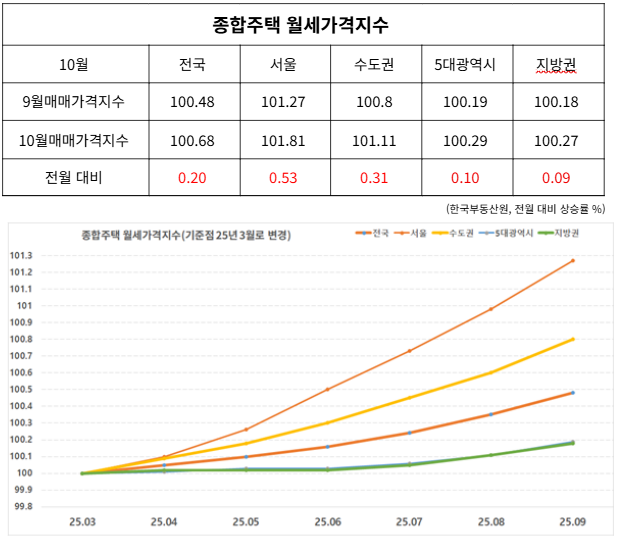
The national monthly rent price index for October 2025 rose by 0.201 TP3T compared to the previous month, expanding from 0.131 TP3T the previous month. Seoul recorded 0.531 TP3T, the Seoul Capital Area 0.311 TP3T, the five major metropolitan cities 0.101 TP3T, and other regions 0.091 TP3T, showing a stable or higher trend across all regions. As the preference for monthly rent over jeonse persists, all districts in Seoul saw significant increases, with Songpa-gu (+1.571 TP3T), Yongsan-gu (+0.891 TP3T), Yangcheon-gu (+0.781 TP3T), and Seongdong-gu (+0.581 TP3T) seeing the largest increases.
In the metropolitan area, the largest increases were seen in complexes with favorable living conditions in Suwon's Yeongtong District (+0.661 TP3T), small-scale developments in Seongnam's Bundang District (+0.601 TP3T), and large-scale complexes in Uiwang City (+0.441 TP3T). Among the five major metropolitan cities and other regions, Ulsan (+0.271 TP3T) and Sejong (+0.651 TP3T) showed the largest increases.
As the loan for jeonse (rental deposits) continues to tighten, a structural change is occurring in which the demand for monthly rent conversion continues to increase, especially among young people and single-person households, due to jeonse insecurity.
<Comprehensive Analysis>
In October 2025, the housing market continued its strong upward trend nationwide, but regional differences were evident. The national housing price index rose 0.291 TP3T from the previous month, marking the seventh consecutive month of gains. In Seoul (0.581 TP3T) and the Seoul Capital Area (0.231 TP3T), gains were driven by redevelopment projects and areas near subway stations.
On the other hand, local areas continued to show weakness and consolidation due to an increase in the number of new occupants and sluggish transactions, resulting in a polarized trend with a strong upward trend centered around Seoul and the metropolitan area and a consolidation trend in local areas.
The jeonse market rose by 0.181 TP3T nationwide, marking the fifth consecutive month of growth. This trend was further strengthened in favored areas, particularly Seoul (0.431 TP3T) and the Seoul Capital Area (0.301 TP3T). While large-scale apartment complexes near subway stations, such as Hanam, Gwacheon, Songpa, and Seocho, saw notable gains, regional areas like Gyeongnam and Jeonbuk showed weakness. The monthly rental market also showed a notable upward trend, rising by 0.201 TP3T nationwide compared to the previous month.
In particular, Seoul (0.53%) and the metropolitan area (0.31%) led the upward trend. With persistent news reports indicating that housing market transactions are freezing following the government's real estate policy announcement on October 15th, attention is focused on how housing market price trends will evolve in response to future policy directions.