<Trading>
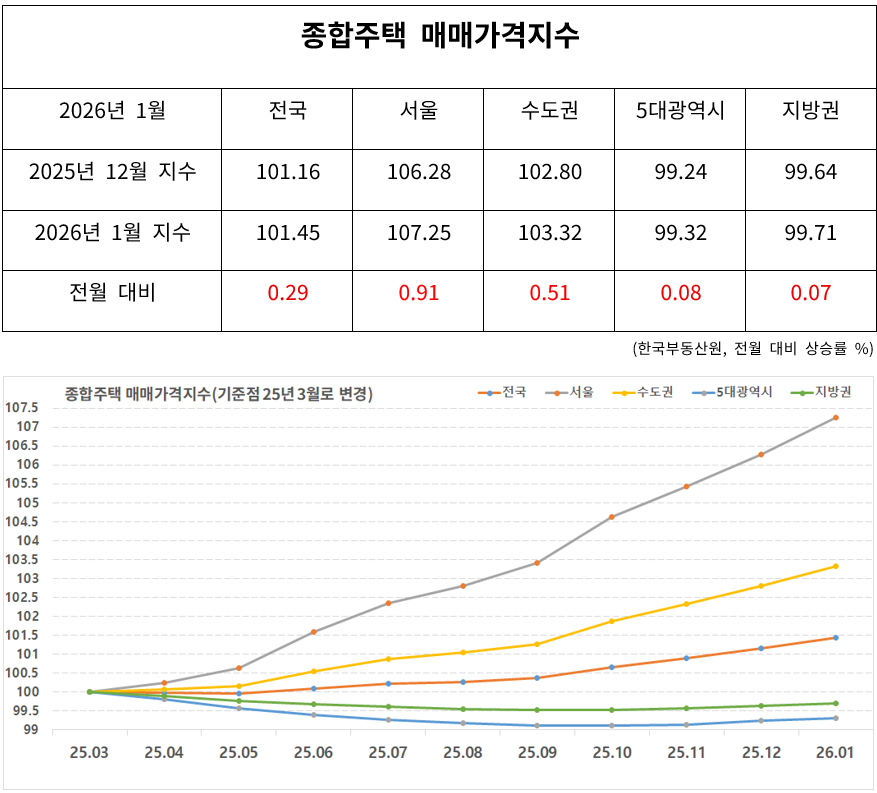
The national housing sales price index in January 2026 rose 0.291 TP3T from the previous month, continuing its upward trend for eight consecutive months. In particular, Seoul showed a larger increase compared to the previous month, rising by 0.91%, and rising transactions continued amid a steady increase in purchase inquiries, especially in preferred complexes with favorable living conditions.
The number of areas with rising prices compared to the previous month rose slightly to 114, while the number of areas with declining prices decreased slightly to 69. In particular, the increase rates were notable in Seoul's upper-middle-income districts, such as Songpa-gu (+1.561 TP3T), Dongjak-gu (+1.451 TP3T), Seongdong-gu (+1.371 TP3T), and Gangdong-gu (+1.351 TP3T).
The Seoul metropolitan area also saw a slight increase, with a 0.511 TP3T increase. The increase was primarily driven by complexes with favorable living conditions, such as Yongin's Suji District (+2.211 TP3T) and Seongnam's Bundang District (+1.661 TP3T). Beyond the Seoul metropolitan area, the five major metropolitan cities and regional areas also saw similar increases compared to the previous month, with increases of 0.081 TP3T and 0.071 TP3T, respectively.
Among metropolitan cities, Ulsan (0.46%) showed the highest increase for three consecutive months, and among local areas, Jeollabuk-do (0.21%) showed the highest increase for three consecutive months, but Jeju (-0.12%) showed the largest decrease due to the continued backlog of unsold inventory.
Although housing prices have been on a steady upward curve since the second half of last year, transaction volume is rapidly declining, and with only a small number of new listings being reported in major regions, attention is focused on whether housing prices will fall in the future due to a decrease in transaction volume and a backlog of properties for sale.
<The World>
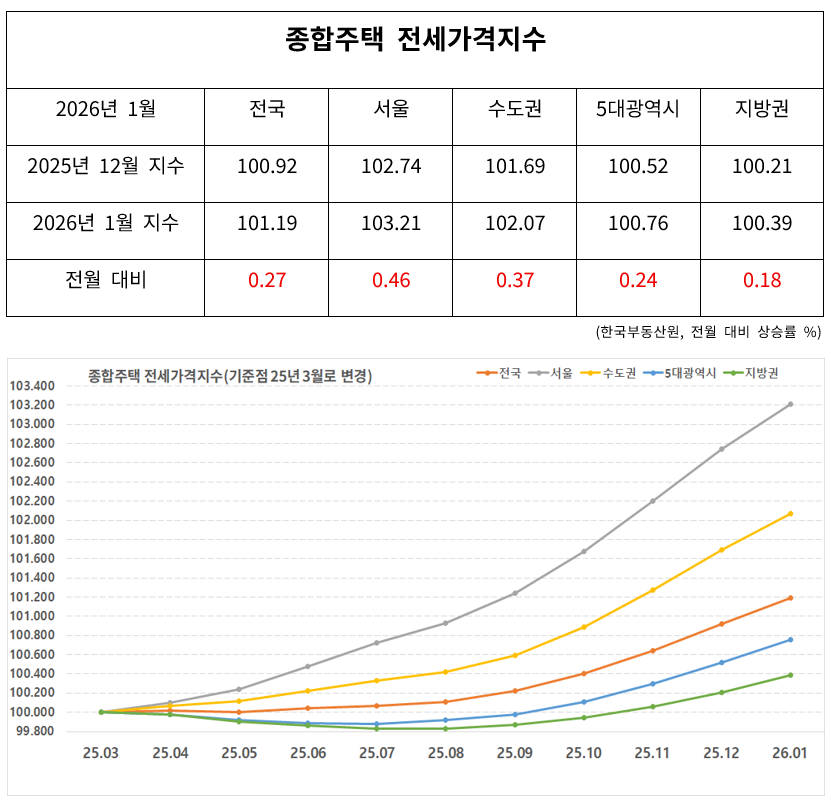
The national rental price index in January 2026 rose 0.271 TP3T from the previous month, marking the eighth consecutive month of increase.
Seoul rose by 0.461 TP3T, showing a slight decrease in the increase rate compared to the previous month, but significantly exceeding the national average. While the supply of properties for sale is not smooth, rental demand continued to rise, mainly in complexes with good living conditions such as large complexes and areas near subway stations, such as Seocho-gu (+1.201 TP3T), Dongjak-gu (+0.671 TP3T), Gangdong-gu (+0.611 TP3T), and Yangcheon-gu (+0.561 TP3T).
The metropolitan area also showed a continuous increase rate, although the increase rate slightly decreased compared to the previous month with a rise of 0.37%. In particular, Suwon Yeongtong-gu (+1.21%) showed an increase mainly in complexes with good living conditions, Anyang Dongan-gu (1.19%) showed an increase mainly in small and medium-sized complexes in Pyeongchon, and Yongin Suji-gu (1.04%) showed an increase mainly in the Dongcheon-dong subway station area.
The five metropolitan cities also showed continued growth, rising by 0.241 TP3T. As with last month, Ulsan (0.561 TP3T) showed the most notable increase. Local areas continued their upward trend, rising by 0.181 TP3T, with Cheongju Heungdeok District (0.621 TP3T) showing the largest increase.
In the metropolitan area and Seoul, prices rose across all housing types, but in the provinces, apartments showed a large increase, while townhouses and single-family homes showed a slight decline, indicating that the gap between apartments and houses has widened.
Monthly rent
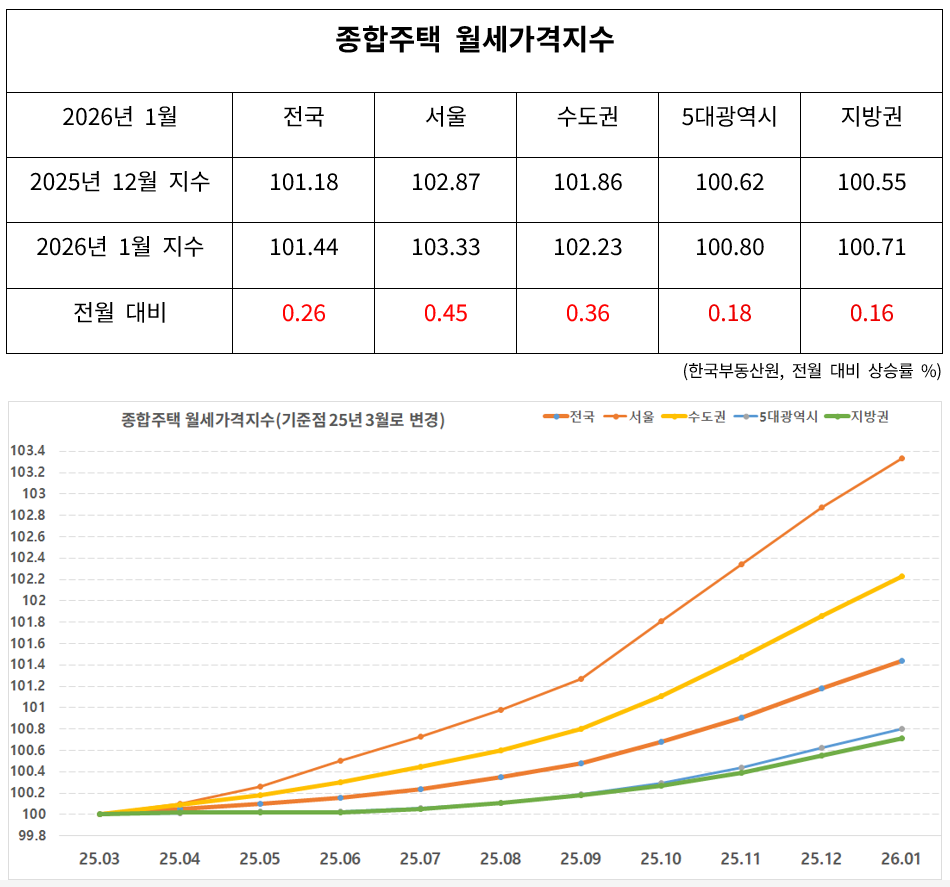
The national monthly rent price index in January 2026 rose by 0.261 TP3T compared to the previous month, showing a similar increase to the previous month. Seoul saw a slight decrease in the monthly increase rate, reaching 0.451 TP3T, and the Seoul Metropolitan Area also saw a slight decrease, reaching 0.361 TP3T. The five major metropolitan cities (+0.181 TP3T) and local regions (+0.161 TP3T) saw similar increases compared to the previous month.
In Seoul, monthly rents continued to rise as demand increased in areas with good locations, such as Seongdong-gu (+0.81%), Seocho-gu (+0.80%), Yeongdeungpo-gu (+0.72%), and Yongsan-gu (+0.67%), and in major complexes, such as Suwon Yeongtong-gu (+1.12%), Anyang Dongan-gu (+0.71%), and Uiwang-si (0.62%), respectively.
In the five metropolitan cities, the shortage of properties in Ulsan (+0.40%) continued, as in the previous month, and prices rose mainly in Dong-gu. In the local areas, Sejong (+0.67%) showed the highest increase, as in the previous month, but Jeju (-0.12%) was the only one among the five metropolitan cities and local areas to show a decline.
Due to regulations on jeonse loans, the preference for monthly rent over jeonse is intensifying among both landlords and tenants, and as the supply of jeonse properties gradually decreases, the preference for monthly rent is expected to continue for some time.
Comprehensive Analysis

In January 2026, the housing market showed a slow recovery, with lending restrictions, interest rate burdens, and a wait-and-see attitude from buyers. While transaction volume nationwide remains below the long-term average, the continued presence of real demand, particularly in urgent sales, has limited the sharp decline in prices.
Core areas of the metropolitan area and complexes with excellent residential conditions showed flat or slight increases, while outlying areas and some rural areas continued to show weaker price movements due to weakened demand, revealing a clear regional polarization. Areas anticipated for reconstruction and redevelopment are experiencing selective demand inflows, driven by policy variables and project progress.
The rental market is becoming increasingly tight due to a decline in the number of available properties and the expiry of renewal contracts. In desirable locations, such as school districts and near subway stations, rental prices have shown a gradual upward trend, while some areas have experienced a shortage of properties for sale. Conversely, in small and medium-sized provincial cities with ample supply, prices have remained flat or even mixed, leading to a sharp differentiation.
The monthly rental market continues to face upward pressure due to growing demand for jeonse (long-term deposits) as an alternative to jeonse (long-term deposits) and a preference for reduced deposit burdens. In particular, the shift to monthly rentals is increasing, particularly for small, downtown housing close to work, demonstrating a continued structural shift in the rental market.