'Winter is coming.' It is a famous line and episode title from the American drama 'Game of Thrones' that was popular worldwide a few years ago. It seems like only yesterday that I took out my thick winter coat while thinking of this phrase, but now the season where we seek shade to avoid the warm sunlight is fast approaching. The seasons repeat like that, and just as the moon wanes and rises again, so do our lives. This providence is not only reflected in nature, but also in cities and spaces.
Euljiro used to be a desolate back alley where printing shops used to close their shutters, but it has been re-evaluated as “Hipjiro” in recent years, and is bustling with people even on weekday evenings. The scenery and atmosphere are changing as if winter is turning into spring.
From 'Gurigae' to 'Hwanggeumjeong' and 'Euljiro'
During the Joseon Dynasty, Euljiro was a relatively underdeveloped area within the four gates of Hanyangdoseong. The area south of Cheonggyecheon, covered with yellow soil, was said to have had a hard land, and the yellow soil that caused the hard land turned copper-colored when exposed to sunlight, hence the name "Gurigae." The old restaurant "Jingogae" that opened in 1963 and has been located in Chungmuro to this day is said to have been named after "Jingogae," another name for the area that had a hard land covered with yellow soil.
During the Japanese colonial period, as foreigners and Japanese began to settle here, the 'moon' of Euljiro began to rise. In 1914, the Government-General of Korea named this area 'Koganemachi (黃金町, Golden Jeong)' and opened a road that runs through the current Euljiro and named it 'Koganemachi-dori (黃金町通り, Golden Jeongtong)'.
The fact that this area was named 'Hwanggeumjeong' symbolizes that at the time, Japan wanted to make this area the central financial and economic district of Seoul.
Because they wanted their base to be in the central area of Seoul, they used the names 'Honcho (本町: Honmachi)' and 'Hwanggeumcho (黃金町: Koganemachi)', and planned and built roads with Seoul as the central axis, and attempted to make the area serve as a center of finance and economy.
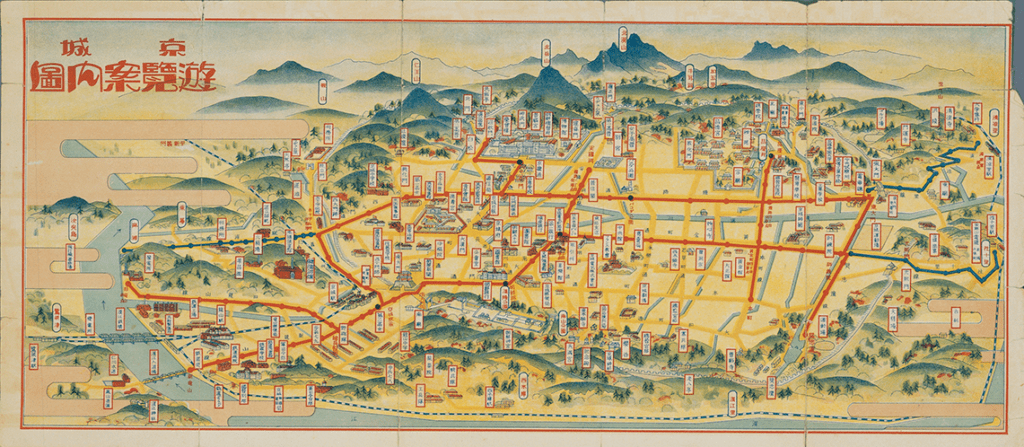
'Gyeongseong Tour Guide Map', a travel guide map produced in the late 1920s Source: Seoul History Archive
It is a bird's eye view of Seoul, including the four gates of Seoul and Yongsan, and shows tram lines, train stations, and major facilities. The red thick solid lines on the map are tram lines at the time. The road name next to the current Myeongdong Cathedral, which is written as "French Church" in Japanese, is written as Yeongnak-cho-tong (永樂町通), so it seems likely that the current "Yeongnak Church" on this road was named after this road.
From the financial center to the printing alley
Many financial companies, including the Oriental Development Company, the 18th Bank, Nippon Life Insurance, Matsuyama Securities, and Yamaguchi Securities, as well as major companies such as Sumitomo and Mitsui, established themselves in Euljiro and prospered. Numerous printing houses and bookbinding shops also came here, becoming the origin of the “Euljiro Printing Alley.” Considering that new cultures and knowledge were born through printing at the time, it can be seen that Euljiro was at its peak during this period and functioned as a center of activity for many intellectuals and writers.
An interesting fact. The world-renowned game company Nintendo (任天堂: Nintendo) operated in Korea during the Japanese colonial period under the name of Nintendo Koppai (Imcheondang Golpae; founded in 1889). According to records from that time, the Korean branch is listed as Kogane-machi 3-chome (Golden Jeong 3-chome), so it is presumed that the branch was located in Euljiro 3-ga. At that time, they manufactured and sold Hwatu, and it is said that they continued to operate until 1945.


Nintendo's guide and Gyeongseong (Seoul) branch during the Japanese colonial period. If you look at the bottom line of the guide, you can see the current address of Euljiro 3-ga as the branch. Source: beforemario. Erik Voskuil
Euljiro's turning point: liberation, war, and Seun Shopping Mall
After liberation, Japanese place names were changed to Korean words. The Honmachi (Myeongdong, Chungmuro) area was renamed Chungmuro after Admiral Yi Sun-sin in order to suppress the Japanese, and the Euljiro area, where Chinese people had formed a Chinatown since the late Joseon Dynasty, was renamed Euljiro after Admiral Eulji Mundeok. Then, the traces of the main residence and living space of the Japanese who had gathered at the foot of Namsan were erased by dividing them in two, and the road from the southern part of Myeongdong to Gwanghwamun was named Toegye-ro after Toegye Yi Hwang.
Euljiro entered a period of change with the fall of Japan and the Korean War in 1950 as major turning points. Just as the rising moon wanes, Euljiro, which had been taking on the appearance of a capitalist modern city with light industries such as printing, finance, and commerce, was left in a chaotic and disorderly state after the Korean War, and slums were formed. This was a phenomenon that occurred when refugees who had lost their hometowns and migrants from the provinces flocked to the ruins and settled there. Euljiro, where residential and commercial functions were mixed in such a chaotic manner, transformed into a space where commercial functions were central as the residents who had formed the slums moved in groups in 1966 when an urban development project was carried out. In 1968, the first commercial-residential complex in Korea, Seun Shopping Center, was built, and it was said that “if you have the blueprint, you can even build a tank in Seun Shopping Center,” which was the center of Korean economic growth.
Its development seemed to be slowing down behind the development of Gangnam, which once led to the revitalization of this area (at the time of the development of Gangnam, the construction-related industries in the Euljiro area benefited greatly from the demand for Gangnam architecture), but it is shining again and rising in the name of 'urban regeneration' following the restoration of Cheonggyecheon.
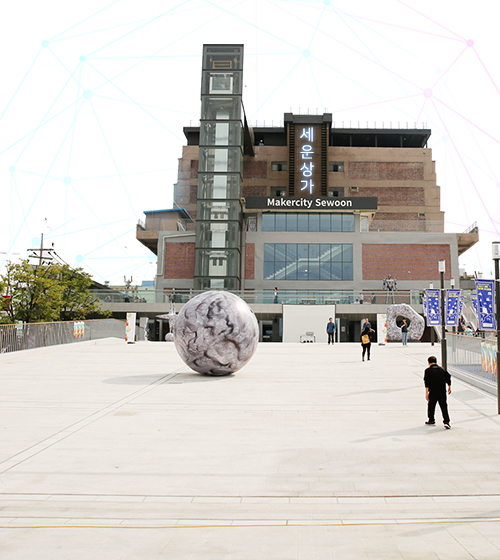
Source: sewoonplaza.com
CBD Commercial Area, Urban Phenomenon Called 'Hipjiro'
As mentioned earlier, the central factor in its transformation into its current form was partly policy factors such as the restoration of Cheonggyecheon, but the role of artists and cultural figures who gathered in Euljiro since the early 2010s cannot be overlooked. For artists who needed to obtain rare parts or materials such as tiles, lighting, tools, hardware, and sewing machines, the alleys of Euljiro, which offered work, exhibitions, and communication at low rents due to the outdated buildings, must have been attractive, and the atmosphere of these alleys, mixed with the so-called 'retro' craze, gradually attracted many young artists and cultural consumers who wanted to communicate with them, forming a commercial district called 'Hipjiro' and taking on a new appearance.
The content provided by cultural artists attracted consumers and investors. This, combined with the supply of large offices in the CBD, led to the development of Center One, Signature Tower, and Eulji Twin Tower, which attracted large office populations. The settlement of a population with purchasing power became a catalyst for the regeneration of the commercial district.
The Nogari Alley, which was represented by Euljiro OB Bear and Manseon Hope, has disappeared after being demolished due to redevelopment, but its place is being filled with another change. Currently, 13 to 14 redevelopment zones are in progress in the Euljiro 3-ga area, and a wide range of urban regeneration projects, including Seun Shopping Center, are being carried out simultaneously.
Euljiro has a high possibility of being reborn as a future-oriented city center where ‘housing + culture + jobs’ coexist.

Crowds of people at the night market in Euljiro Nogari Alley before demolition due to redevelopment. The pubs that used to guard Euljiro Nogari Alley, such as ‘Manseon Hof’, ‘Eulji OB Bear’, and ‘Munich Hof’, and the numerous people who visited them. Source: Korea Tourism Organization
The culture and content created by artists who have moved into Euljiro are like a never-ending lifeline, going beyond simple creation and bringing about an influx of cultural and commercial consumers, which has also been intertwined with the regeneration of the CBD area. From Euljiro 4-ga Station to Euljiro 4-ga Station, large offices have been built one after another against the backdrop of urban regeneration and redevelopment, and as a result, the influx of people with high purchasing power has given the 'Hipjiro' phenomenon even more momentum. The supply of large offices has played a major role in revitalizing the commercial district of this area, and as if heralding a great transformation into a business district centered around Euljiro 3-ga Station, the active construction site visible beyond the tall fences erected along the main street foretells that the consumption infrastructure of this area will be further strengthened.
Change seems to be progressing slowly, but if you pay a little attention, it is progressing without stopping. Along the street from Euljiro 3-ga Police Station to Euljiro 4-ga, existing building materials and lighting stores are being converted into restaurants one by one, and the inner alley commercial districts are also expanding toward Chungmuro. From the first quarter of 2022 to the fourth quarter of 2024, the rent increase rate of medium and large-sized stores in Euljiro will reach a whopping 50%, which is an overwhelming figure that overwhelms the 10% increase rate of major commercial districts in Myeongdong and Gangnam during the same period.
Of course, these figures and phenomena do not simply lead to a positive evaluation of the changes in the Euljiro commercial district. As is often mentioned in the case of Gyeongridan-gil, there are concerns that if a commercial district grows rapidly and consumer power is concentrated, an inevitable gentrification phenomenon may occur. The more a commercial district grows, the more it needs to consider the inevitable phenomena that follow, and it is necessary to carefully examine how 'gentrification' will affect the Euljiro commercial district.
Outlying commercial districts such as Gyeongridan-gil have weak intrinsic purchasing power and rely on the uniqueness and atmosphere of the commercial district to attract outside consumers, so large-scale capital inflow can actually be toxic. Higher rents cause members who supported the original identity of the commercial district to leave, and as a result, commercial districts that lose their unique charms will decline as consumer inflow decreases.

However, Euljiro needs to be viewed from a different perspective. There are several areas in Seoul designated as commercial districts, but most of them are general commercial districts. Gangnam Business District (GBD) and Yeouido Business District (YBD) are both general commercial districts, and the areas designated as central commercial districts are limited to Myeongdong and Euljiro in the entire Seoul. This means that Euljiro is the most central location among Seoul's commercial districts.
In the future, Euljiro will have a strong consumer base internally and a structure that can expect a constant influx externally. Unlike existing outlying commercial districts, gentrification in such a commercial district is more likely to result in expansion and fixation of the commercial district rather than reduction or relocation of the commercial district.
In particular, the Euljiro area, including CBD, is being reorganized into a space that can continuously attract people by combining it with Seoul's various tourist contents based on a fixed population with high purchasing power.
This will further strengthen Euljiro as a complex place where the past, present, and future of Seoul coexist, and the social phenomenon of gentrification can also provide a more rational analytical perspective for real estate investors, as it can lead to expansion of the center and exchange and solidification with surrounding commercial districts rather than a decline in the commercial district.
The 'Hipjiro' commercial district (it is more appropriate to call it 'Hipjiro' rather than 'Euljiro commercial district' to explain the unique commercial district expansion characteristics of this area) is already expanding toward Chungmuro. This is because the foundation for supporting fixed consumption power, such as the construction of new hotels and offices in Chungmuro, is being formed, and the commercial district's expansion speed is also accelerating. The urban regeneration and redevelopment encompassing the Seun Shopping Center area and Euljiro 4-ga area may feel somewhat slow in the future, but unless there are special variables, it is highly likely that it will gradually grow in size and speed like a rolling snowball.
Long ago, not by our will, Euljiro began to rise to the center of Seoul, and it even tilted in the great stream of history. But now, it is ready to rise again. Soon, Euljiro will shine brightly in the center of Seoul like a full moon.
The moon is rising, let's go. Euljiro.
Remax Master, CBD Area Expert
Remax Meister, where I work, is located in Mugyo-dong, Jung-gu, Seoul, and provides customized 1:1 real estate consulting based on deep understanding and expertise in central commercial areas of Seoul, including Myeong-dong.
Remax Meister provides accurate analysis and strategies on the domestic and international real estate markets based on extensive data from experienced real estate experts, and suggests optimized investment and business strategies to customers.
Inquiry 1533-3088 Address 901, Gwangil Building, 11 Mugyo-dong, Jung-gu, Seoul