2025.3 Comprehensive Housing Price Index

Note
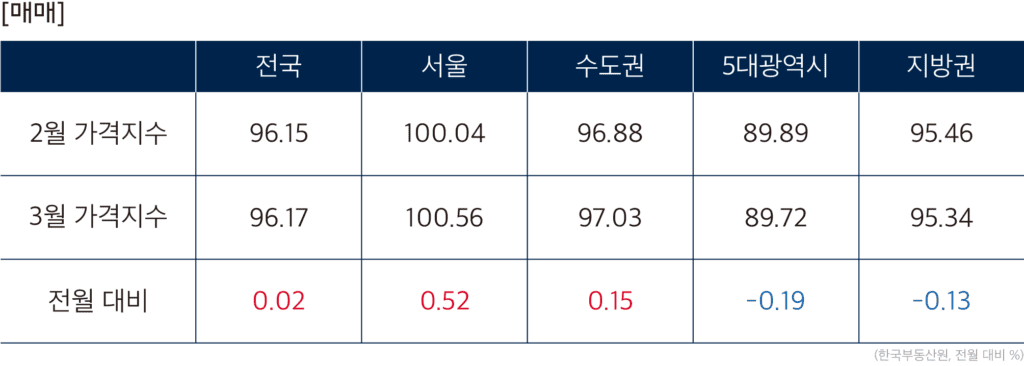
The comprehensive housing transaction price index rose significantly in Seoul (0.52%) compared to the previous month, but rose slightly in the metropolitan area (0.15%) and fell in the five major metropolitan cities (-0.19%) and local areas (-0.13%), finishing flat nationwide (0.02%). In Seoul, rising contracts continued in complexes with good living conditions, such as those near subway stations, new construction, and large complexes, and some preferred complexes showed a shortage of properties for sale, expanding the increase compared to the previous month. Gyeonggi (0.07%) fell centered on Gwangmyeong, Pyeongtaek, and Anseong, but expanded the increase centered on Gwacheon, Anyang Dongan, Yongin Suji, and Suwon Yeongtong-gu. Incheon (-0.01%) rose centered on Michuhol and Yeonsu-gu, but continued to decline when Seo-gu and Jung-gu fell.
In Seoul, the northern part of the river decreased mainly in Sanggye and Junggye-dong in Nowon-gu (-0.01%), but the Seongdong-gu (0.90%) rose mainly in the Geumho and Haengdang-dong area, the Yongsan-gu (0.67%) rose mainly in the major complexes of Ichon-dong and Hangang-ro, the Mapo-gu (0.58%) rose mainly in Ahyeon and Yeomri-dong, and the Gwangjin-gu (0.42%) rose mainly in Gwangjang and Jayang-dong. In the southern part of the river, the Gangnam-gu (2.00%) rose mainly in Apgujeong, Daechi, and Gaepo-dong, the Songpa-gu (1.71%) rose mainly in the major complexes of Jamsil and Sincheon-dong, and the Seocho-gu (1.60%) rose mainly in Banpo and Jamwon-dong, showing a large increase across the Seoul metropolitan area. It seems that the three districts of Gangnam led the large increase as demand for quick gap investment poured in before the land transaction permit system was re-designated on March 24. In the local areas, Daegu (-0.34%) fell mainly in Buk and Suseong districts, Sejong (-0.32%) fell mainly in Goun and Hansol-dong due to the backlog of properties for sale, Gwangju (-0.19%) fell mainly in Nam and Gwangsan districts due to the supply effect, and Busan (-0.17%) fell mainly in Gangseo and Sasang districts due to the unsold properties effect.
Note
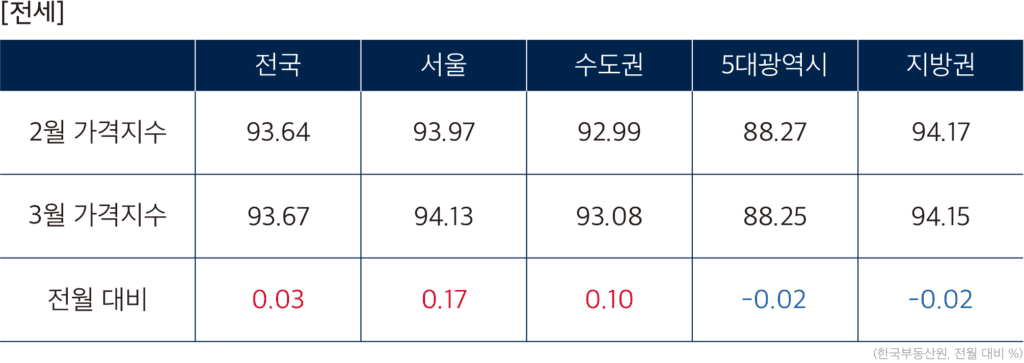
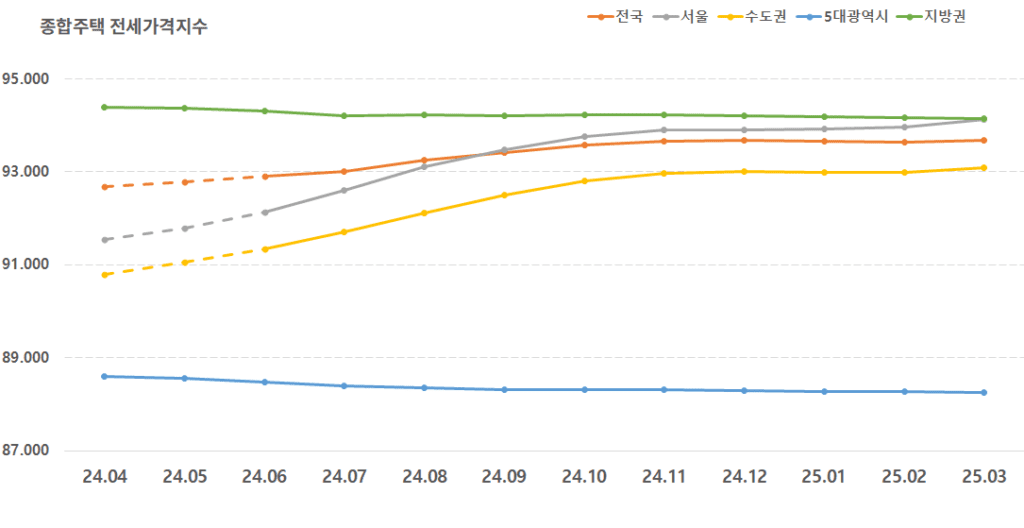
The jeonse price index rose slightly in Seoul (0.17%) and the metropolitan area (0.10%), while the five metropolitan areas were flat or slightly down, and nationwide (0.03%) it turned from a decline (-0.01%) to an increase. In Seoul, jeonse prices fell in some areas affected by the amount of new housing and in the outskirts, but as contracts for increase were signed centered on preferred complexes, the entire city of Seoul turned from a flat trend to an increase. Incheon fell mainly in Seo-gu/Jung-gu due to the amount of new housing, while Gyeonggi turned to an increase overall, with Gwacheon-si/Yongin-si rising.
In the northern part of Seoul, Seongbuk-gu (-0.05%) saw a decline centered on new construction in Seongbuk-dong and Jangwi-dong, and Dongdaemun-gu (-0.05%) saw a decline centered on Jeonong-dong and Imun-dong, but Yongsan-gu (-0.24%) saw a rise centered on major complexes in Ichon-dong and Hannam-dong, Seongdong-gu (0.21%) saw a rise centered on small and medium-sized complexes in Eungbong-dong and Hawangsimni-dong, and Nowon-gu (0.21%) saw a rise centered on areas near subway stations in Hagye-dong and Junggye-dong. In Gangnam, Songpa-gu (0.67%) rose mainly in Sincheon-dong and Jamsil-dong, Gangdong-gu (0.40%) rose mainly in semi-new construction in Dundun-dong and Amsa-dong, Dongjak-gu (0.33%) rose mainly in areas near stations in Sindaebang-dong and Sadang-dong, and Yeongdeungpo-gu (0.30%) rose mainly in large-scale complexes in Daerim-dong and Yeouido-dong. Among local areas, Ulsan (0.21%) rose mainly in complexes with good living conditions in Buk-gu and in Dong-gu, but Daegu (-0.22%) fell mainly in Nam-gu, Suseong-gu, and large-scale construction and complexes in Jung-gu, Jeju-do (-0.16%) fell mainly in Seogwipo-si due to the backlog of properties for sale, and Chungnam-do (-0.06%) fell mainly in Hongseong-gun and Dangjin-si, showing an overall decline.

Note
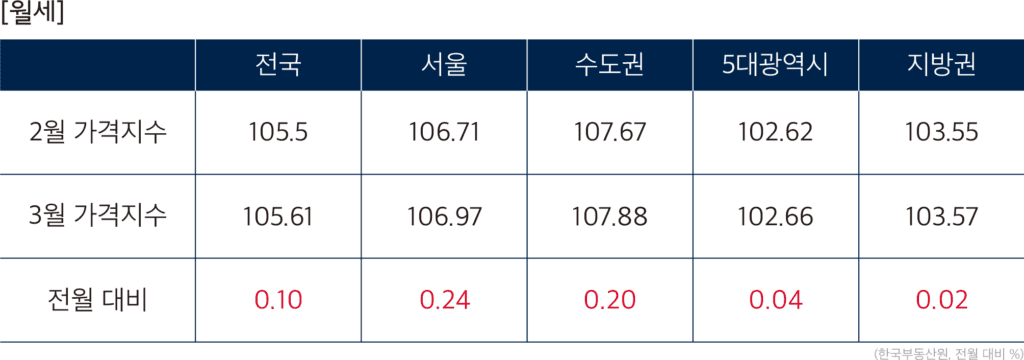
The monthly rent price index showed a similar level to the previous month, with a nationwide increase of 0.10%. In Seoul (0.24%), the increase expanded as the monthly rent preference phenomenon continued due to low initial costs and demand for new rentals, and in the metropolitan area (0.20%), it decreased mainly in Gwangmyeong-si, but increased mainly in Gwacheon-si and Seongnam Sujeong-gu, and in Incheon (0.21%), it increased mainly in Namdong-gu, Jung-gu, and Bupyeong-gu. In the northern part of Seoul, Yongsan-gu (0.32%) led the rise mainly in Munbae-dong, where supply is insufficient, and Mapo-gu (0.27%) led the rise mainly in small and medium-sized apartments in Dohwa and Gongdeok-dong. In the southern part of Seoul, Songpa-gu (0.39%) led the rise mainly in Sincheon, Munjeong, and Jangji-dong, Yeongdeungpo-gu (0.35%) led the rise mainly in Singil and Daerim-dong, and Seocho-gu (0.33%) led the rise mainly in the area around stations in Seocho and Bangbae-dong. In the provinces, Jeju (-0.18%) led the decline mainly in Seogwipo-si, which was affected by supply, but Ulsan (0.23%) led the rise mainly in small-sized apartments in Ulju-gun, remaining in the consolidation zone overall.
It appears that sales have increased significantly due to the demand from gap investors who want to invest quickly before the redesignation of the land transaction permit system on March 24, but the monthly rent showed a similar level of fluctuation as the average month. Attention is being paid to what effect the land transaction permit system for apartments in the three districts of Gangnam and Yongsan will have on the monthly rent.