
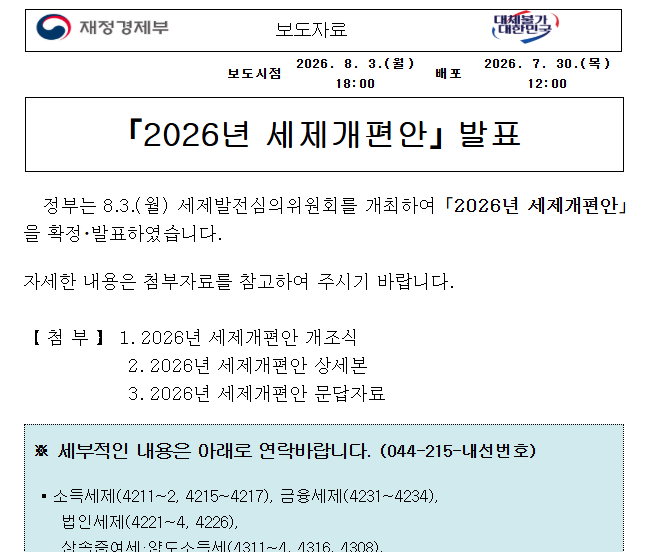
The tax reform plan was announced on August 3, 2026. Among the items included, I would like to discuss the capital gains tax, which is a real estate-related tax. While tax reform bills during the Moon Jae-in administration primarily focused on regulating multi-home owners, the emphasis of this current reform plan appears to be on taxing non-residential and high-priced housing.
 Prior to full implementation in 2029, regulations at the level of current tax laws will be applied in 2027. In 2028, a residency-based tax law that is stricter than that of 2027 will be applied.
Starting in 2029, the application of tax laws will change completely to a residency-based system. I will examine the tax reform proposal in the order of its application dates.
Regulations effective from October 1, 2026
① Shortening the deadline for the transfer of a temporary second home.
Currently, regardless of whether the property is located in an adjustment area, the previous home must be disposed of within three years. Under the revised tax law, if a new home is acquired in an adjustment area while the previous home is still owned, the disposal period for the previous home is shortened from three years to two years. Previously, the disposal period was also two years, but it was extended to three years through an amendment to the enforcement decree on or after January 12, 2023.
 ② It is the gradual abolition of the heavy taxation exclusion for apartments that have been automatically deregistered.
Currently, apartments that have been automatically deregistered were exempt from the heavy capital gains tax regardless of the disposal deadline. The revised tax law specifies a disposal deadline, stipulating that such exemptions apply only to transfers made by December 31, 2027. Exceptions, such as the designation of new adjustment areas and ongoing reconstruction or redevelopment projects, have also been taken into account.
However, even if disposed of within 2028, the reduced heavy tax rate of 50% will be applied, and the special long-term holding deduction for income generated during the rental period will also be lowered from the existing 50% to 30%. In other words, transfers in 2027 are exempt from the heavy tax, while transfers in 2028 are subject to the reduced heavy tax.

③ Abolition of mutually beneficial rental housing.
Personally, I believe this has a significant impact. Currently, if the requirements for mutually beneficial rental housing are met, the two-year residency requirement for the last remaining home is recognized without a disposal deadline. Under the revised tax law, if the mutually beneficial lease agreement is met, the property must be transferred by December 31, 2027, to be eligible.
If a mutual lease agreement is terminated after January 1, 2027, it must be transferred by the earlier of the date one year after the termination of the contract or December 31, 2029, to be subject to the provisions. Since the regulations apply only if the mutual lease agreement is commenced by December 31, 2026, it appears that there will be many cases where the mutual lease agreement is not satisfied depending on the judgment of the previous lease agreement.
Regulations effective from January 1, 2027
① Expansion of the basic deduction for long-term resident single-home owners.
Currently, a deduction of 2.5 million won per person per year is provided, but the deduction amount will be increased to 25 million won in the case of 1) residence for 10 years or more + 2) transfer price of 3 billion won or less + 3) eligibility for tax exemption on a single-household-one-home.
For example, if a house with an acquisition cost of 1 billion won is sold as a single-family home (sole ownership) for 3 billion won after residing in it for more than 10 years, the tax incurred if sold in 2026 is approximately 78 million won, including local taxes. If sold in 2027, the tax is approximately 68 million won, including local taxes, resulting in a tax benefit of about 10 million won. If the property is jointly owned by a married couple, each can receive a deduction of 25 million won, resulting in a tax benefit of approximately 17 million won. However, since this regulation excludes transfers between related parties and non-residents, it cannot be applied to transactions with children.
② The heavy capital gains tax on multi-home owners will also be temporarily eased.

Currently, a heavy taxation rate of +201 TP3 Tp is applied for two-home owners, and +301 TP3 Tp for three-home owners. Under the revised tax law, for capital gains in 2027 (including cases where a capital gain in 2026 is reported in 2027), +51 TP3 Tp is applied for two-home owners, and +101 TP3 Tp is applied for three-home owners. For capital gains in 2028, +101 TP3 Tp is applied for two-home owners, and +151 TP3 Tp is applied for three-home owners. However, the special deduction for long-term holding is excluded regardless of the easing of the heavy taxation.
Regulations effective from January 1, 2028
 ① It is a change in the long-term holding special deduction to be centered on residence.
Currently, the special long-term capital gains deduction for first-time homebuyers applies a maximum deduction of 801 TP3T, calculated by adding 41 TP3T per year of ownership and 41 TP3T per year of residence, for a total of 401 TP3T for each year. Starting in 2028, this will be revised to 21 TP3T per year of ownership and 61 TP3T per year of residence. From 2029, it will be revised to a long-term residence income deduction focused entirely on residence, with 81 TP3T per year of residence. Regarding the special long-term capital gains deduction for multi-home owners, while currently 21 TP3T per year of ownership with a maximum of 301 TP3T over 15 years is applied, starting in 2028, the higher of the following deduction rates will be applied: 11 TP3T per year of ownership with a maximum of 151 TP3T over 15 years, or 21 TP3T per year of residence with a maximum of 301 TP3T over 15 years. From 2029, 21 TP3T will be applied for each year of residence, up to a maximum of 301 TP3T over 15 years.
② A limit on the long-term residency income deduction is newly established.
Currently, the special long-term capital gains deduction could be applied up to a maximum of 801 TP3T without any limit. Under the revised tax law, a deduction limit of 2 billion won (per person and per property) will be applied in 2028, and 1 billion won in 2029. For a single-home owner, if the taxable capital gain exceeds 1.25 billion won, it may be subject to the 1 billion won limit. In the case of ultra-high-priced homes, the tax burden resulting from this could increase significantly.
For example, if a house with an acquisition price of 2 billion won is sold for 5 billion won as a single-family home (sole ownership) after residing in it for more than 10 years, under the existing tax law, a tax of approximately 170 million won, including local taxes, is incurred; however, under the revised tax law, due to the deduction limit of 1 billion won, a tax of approximately 560 million won, including local taxes, is incurred.
In summary,

Ultimately, this reform has shifted the focus of taxation from “how many houses you have owned and for how long” to “whether you are actually living in that house now.” Mechanisms that provided benefits based solely on 'ownership,' such as mutually beneficial rental housing and the exemption from heavy taxation due to automatic cancellation, will be phased out, and even the special long-term ownership deduction will be redesigned to reduce the weight given to the ownership period and increase the weight given to the period of residence. Now is the time to examine the disposal deadline and mutual lease agreement requirements for multi-home owners or rental business operators, and the residency period and deduction limits for owners of a single high-priced home. Given that the relaxed regulations for 2027 are effectively a grace period for full implementation in 2029, this is not an issue to be put off as something to be discussed later.