<Buying and Selling
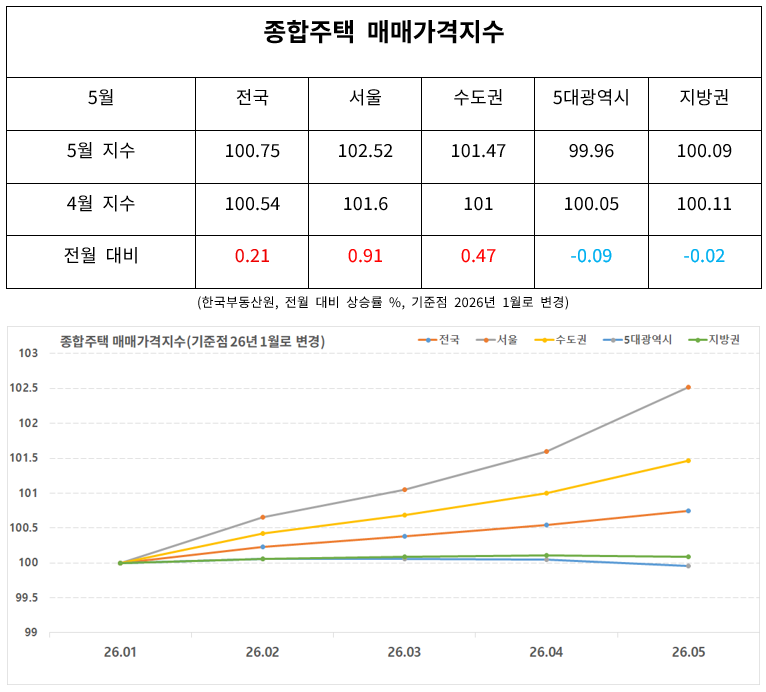
According to the National Housing Price Trends Survey for May 2026 released by the Korea Institute of Real Estate, the national comprehensive housing sales price index continued its upward trend, rising 0.211 TP3T compared to the previous month.
While the Seoul metropolitan area rose by 0.471 TP3T, provincial areas fell by -0.021 TP3T, further exacerbating regional polarization. In particular, Seoul showed the strongest upward trend nationwide, rising by 0.911 TP3T. Within Seoul, Seongbuk-gu (1.361 TP3T), Songpa-gu (1.191 TP3T), Gwangjin-gu (1.181 TP3T), and Seongdong-gu (1.071 TP3T) recorded high growth rates.
The Gyeonggi region rose by 0.311 TP3T, led by Gwangmyeong-si (2.011 TP3T), Hwaseong Dongtan-gu (1.571 TP3T), and Anyang Dongan-gu (1.481 TP3T). On the other hand, Gwangju (-0.521 TP3T), Jeju (-0.171 TP3T), Sejong (-0.161 TP3T), and Daegu (-0.141 TP3T) showed a downward trend.
While core areas of the Seoul metropolitan region are driving price increases driven by a simultaneous influx of both end-user and investment demand, regional disparities are intensifying in the provinces due to the impact of economic recession and population decline. These statistics indicate that the domestic housing market has entered a phase of selective growth centered on Seoul and parts of the metropolitan area, rather than a nationwide bull market.
<Jeonse
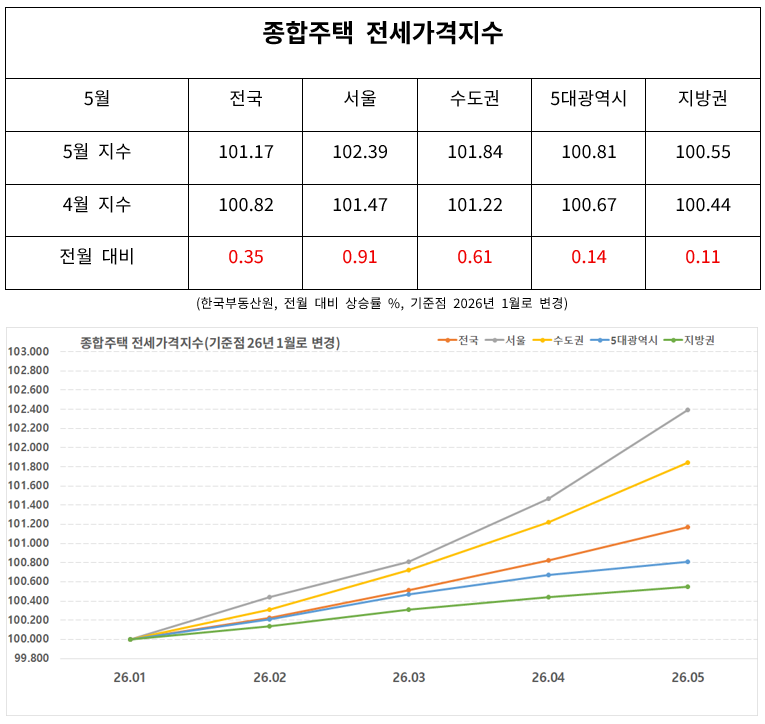
In May 2026, the nationwide comprehensive housing Jeonse price index rose by 0.351 TP3T compared to the previous month, showing a stronger upward trend than the sales market.
While the metropolitan area rose by 0.611 TP3T, provincial areas increased by only 0.111 TP3T, confirming the concentration of the Jeonse market in the metropolitan area as well. Seoul recorded the highest growth rate in the country, rising by 0.911 TP3T. In Seoul, Songpa-gu (1.621 TP3T), Seongdong-gu (1.441 TP3T), Nowon-gu (1.401 TP3T), Seongbuk-gu (1.301 TP3T), and Dobong-gu (1.131 TP3T) led the increase.
The Gyeonggi region rose by 0.511 TP3T, with Gwangmyeong-si showing strength at 1.881 TP3T, Hwaseong Dongtan-gu at 1.501 TP3T, and Suwon Yeongtong-gu at 1.281 TP3T. Incheon also continued its recovery trend, rising by 0.271 TP3T. In the provinces, Ulsan 0.42%, Sejong 0.43%, Busan 0.26%, and Jeonbuk 0.21% rose, while Jeju -0.17%, Gwangju -0.07%, and Daegu -0.03% fell.
Number of Jeonse properties due to continuous rental demand and rising sales pricesThe expansion of the market is driving demand, and a shortage of Jeonse listings persists, particularly centered around major large-scale complexes and subway stations in Seoul. It appears highly likely that the strength of the Jeonse market will continue, depending on future housing supply and interest rate conditions.
<Monthly Rent >
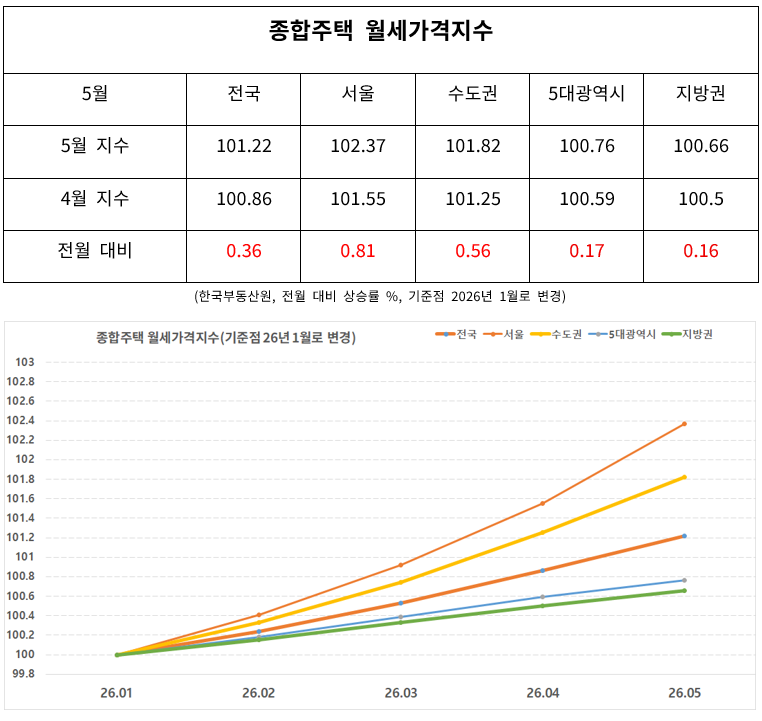
In May 2026, the nationwide comprehensive housing monthly rent price index rose by 0.361 TP3T compared to the previous month, continuing a stable upward trend.
With the metropolitan area recording a rise of 0.561 TP3T and the provinces a rise of 0.161 TP3T, the monthly rent market also showed strength centered on the metropolitan area. Seoul recorded the highest growth rate nationwide at 0.811 TP3T, with Seongdong-gu (1.271 TP3T), Songpa-gu (1.301 TP3T), Nowon-gu (1.401 TP3T), Mapo-gu (1.031 TP3T), and Seongbuk-gu (1.101 TP3T) leading the upward trend.
Monthly rent demand expanded across the metropolitan area, with Gyeonggi rising by 0.471 TP3T and Incheon by 0.291 TP3T. In the provinces, Ulsan rose by 0.431 TP3T, Jeonbuk by 0.251 TP3T, Sejong by 0.231 TP3T, Busan by 0.211 TP3T, and Gyeongnam by 0.211 TP3T, while only Jeju fell by -0.151 TP3T.

Recently, due to rising Jeonse prices and the increasing burden of Jeonse funds, the preference for monthly rent is expanding. In particular, demand for monthly rent is steadily increasing in Seoul and the metropolitan area, which have a large number of young adults and one- or two-person households. Consequently, the monthly rent market is maintaining a relatively stable upward trend compared to the sales or Jeonse markets, and its influence as the central axis of the rental market is expected to further expand in the future.
<Comprehensive Analysis>
In May 2026, the housing market recorded an upward trend in sales, Jeonse, and monthly rent, but the center of the rise was concentrated in Seoul and the metropolitan area. Seoul led the national market with increases of 0.901 TP3T in sales, 0.911 TP3T in Jeonse, and 0.811 TP3T in monthly rent, with strong performance notable in key areas such as Gwangmyeong, Dongtan, Seongdong, and Songpa.
In contrast, sales prices in provincial areas remained virtually flat at -0.021 TP3T, intensifying regional polarization. In particular, the fact that the growth rate of Jeonse prices was higher than that of sales prices is interpreted to mean that housing demand driven by actual needs remains strong. Furthermore, it is observed that the rise in Jeonse prices is leading to an increase in monthly rent prices.
Overall, the current market is not a nationwide bull market but rather a selective upward phase centered on key areas of Seoul and the metropolitan region, and regional disparities are highly likely to widen further depending on future changes in interest rates and supply volumes.