2025.2 Comprehensive Housing Price Index

Note
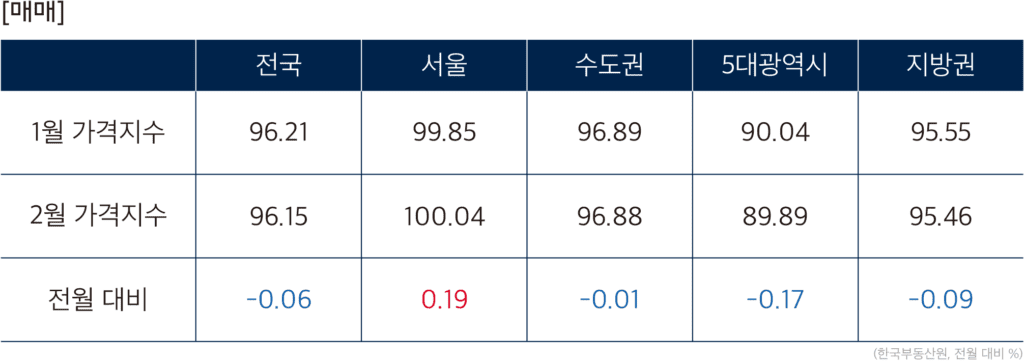
The comprehensive housing transaction price index rose in Seoul (0.19%), but remained flat in the metropolitan area (-0.01%), and fell in the five major metropolitan cities (-0.17%) and local areas (-0.09%). The number of rising regions (45 → 59) increased compared to the previous month, the number of flat regions (0 → 3) also increased, and the number of falling regions (133 → 121) decreased, finishing with a nationwide decline (-0.06%), but the decline compared to the previous month decreased. In Seoul, the increase was expanded compared to last month, centered around Songpa-gu, Seocho-gu, and Gangnam-gu, while showing a mixed trend by region and complex. Incheon fell centered around Yeonsu-gu, Gyeyang-gu, and Seo-gu, and in Gyeonggi-do, the decline was expanded in Gwangmyeong-si and Pyeongtaek-si, which are affected by the amount of housing available, and the downward trend continued.
In Seoul, in the Gangbuk (0.04%) area, prices fell mainly in Sanggye and Hagye-dong in Nowon-gu (-0.07%), and in Dobong-gu (-0.04%) mainly in Banghak and Chang-dong, but prices rose mainly in Ichon and Hyochang-dong in Yongsan-gu (0.24%), mainly in the major complexes of Gwangjang and Jayang-dong in Gwangjin-gu (0.14%), and mainly in Yeomri and Ahyeon-dong in Mapo-gu (0.14%). In Gangnam (0.05%), prices fell mainly in Guro-gu (-0.03%) and Gaebong-dong, and in Geumcheon-gu (-0.01%), prices fell mainly in Doksan-dong and Siheung-dong. However, prices rose mainly in Songpa-gu (0.94%) and Jamsil-dong, Seocho-gu (0.74%) and Daechi-dong and Cheongdam-dong, respectively. In Incheon (-0.20%), Yeonsu-gu (-0.33%) saw a decline centered on Yeonsu and Dongchun-dong construction, Gyeyang-gu (-0.31%) saw a decline centered on Hyosung and Jakjeon-dong, which are areas with an increase in unsold units, Seo-gu (-0.27%) saw a decline centered on Cheongna and Gajeong-dong, and Namdong-gu (-0.23%) saw a decline centered on Nonhyeon and Mansu-dong. In the Gyeonggi region, Gwacheon-si (0.41%) showed a large increase, but Gwangmyeong-si (-0.53%) saw a large decrease centered on Cheolsan and Haan-dong, and Pyeongtaek-si (-0.52%) saw a large decrease centered on Anjung and Cheongbuk-eup, which are affected by the supply volume, expanding the decrease compared to the previous month.

Note
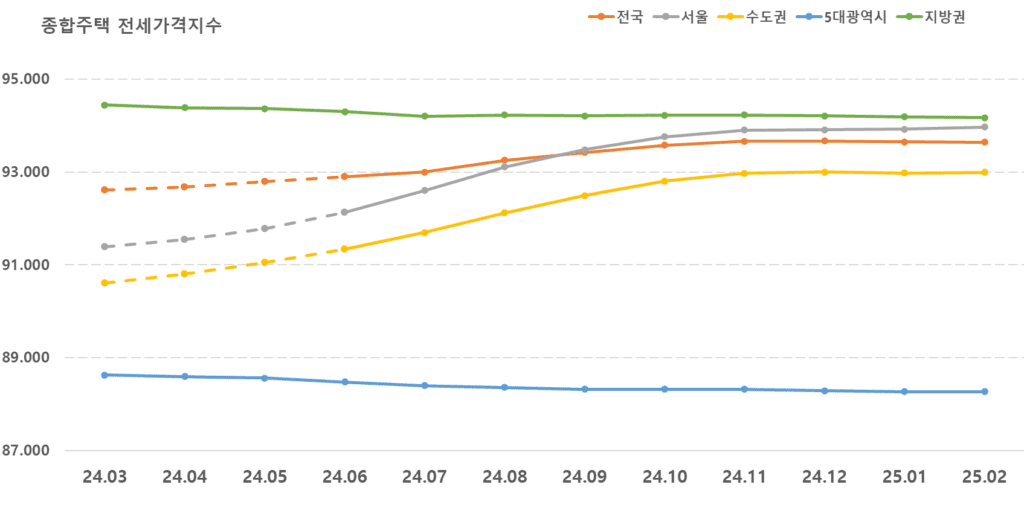
The jeonse price index continued to rise in 2024, but it ended in a nationwide flat or slight decline from January of this year. Compared to the previous month, the rising area (87→93) increased, the flat area (7→2) decreased, and the falling area (84→83) decreased slightly. In Seoul, the jeonse price decreased in some areas affected by the number of occupants and in the outskirts, but the entire Seoul turned from flat to rising as rising contracts were signed centered on preferred complexes. Incheon decreased mainly in Seo-gu/Jung-gu due to the number of occupants, and Gyeonggi turned to an increase overall, with Gwacheon-si/Yongin-si rising.
In Seoul, in the Gangbuk (0.01%) area, Seongdong-gu (-0.14%) fell mainly in Haengdang and Hawangsimni-dong, which are affected by the amount of new housing, and Dongdaemun-gu (-0.11%) fell mainly in Jangan and Jeonong-dong, but Dobong-gu (0.09%) rose mainly in the major complexes of Banghak and Ssangmun-dong, Nowon-gu (0.09%) rose mainly in the area around Junggye and Gongneung-dong, and Yongsan-gu (0.06%) rose mainly in Hannam and Ichon-dong, turning the Gangbuk area upward. In Gangnam (0.10%), Guro-gu (-0.06%) fell mainly in Sindorim and Hang-dong, and Gwanak-gu (-0.04%) fell mainly in Namhyeon and Bongcheon-dong, which are affected by the amount of new housing units. However, Songpa-gu (0.31%) rose mainly in large-scale complexes in Sincheon and Bangi-dong, Gangseo-gu (0.14%) rose mainly in areas near stations in Gayang and Magok-dong, and Yeongdeungpo-gu (0.14%) rose mainly in Daerim and Yeongdeungpo-dong. After a year of increase in 2024, jeonse prices are showing signs of stabilizing nationwide.


Note
The monthly rent price index rose slightly nationwide by 0.11% compared to the previous month. In Seoul, the increase expanded due to the continued preference for monthly rent and steady rental demand caused by loan regulations. Incheon rose mainly in Namdong, Gyeyang, Seo, and Jung-gu, and Gyeonggi rose mainly in Gwacheon, Seongnam, Ilsan, and Suwon. Among the five metropolitan cities, Daegu fell mainly in Suseong and Nam-gu, but Ulsan rose mainly in Ulju-gun and Nam-gu, expanding the increase in the five metropolitan cities. In other regions, Gangwon-do and Chungcheongbuk-do saw an increase in the increase, but Jeju-do saw an increase in the decrease, and Chungcheongnam-do turned from an increase to a decrease, reducing the increase in eight provinces.
In the case of sales, it appears that the overall asking price and actual transaction price have risen, especially in the three districts of Gangnam, as the land transaction permit system was lifted in some areas of Seoul on February 12. (The land transaction permit system for the three districts of Gangnam and Yongsan-gu was redesignated as of March 19.) Accordingly, monthly rent is also expected to see some upward momentum, but attention is focused on whether this will be a temporary phenomenon or whether it will continue to rise in the future.