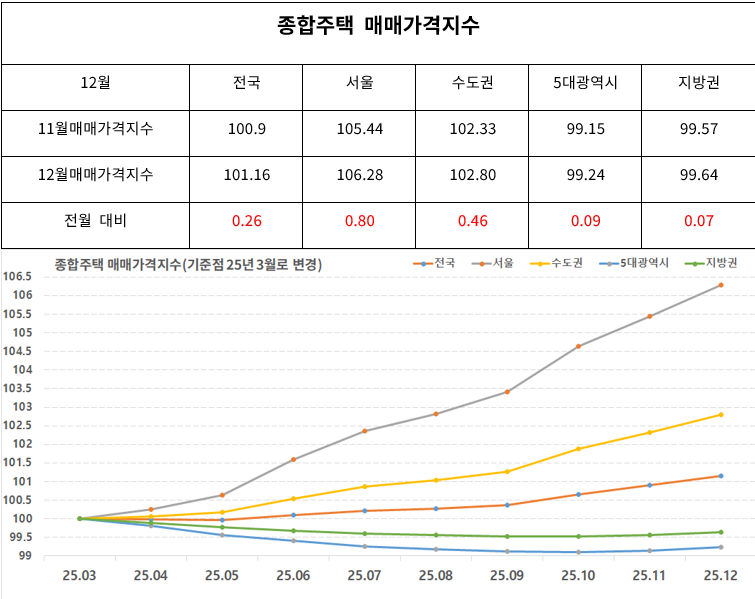
[Korea Real Estate Board, Month-on-Month Increase of %]
The national housing price index rose 0.261 TP3T in December 2025 compared to the previous month, continuing its upward trend for seven consecutive months. Seoul, in particular, saw a significant increase, rising 0.801 TP3T. This increase was driven by increased inquiries and transaction volume, particularly in desirable complexes near subway stations and those facing redevelopment issues. The number of areas experiencing price increases slightly decreased from the previous month to 113, while the number of areas experiencing price decreases slightly increased to 64. Songpa-gu (+1.721 TP3T), Yongsan-gu (+1.451 TP3T), Dongjak-gu (+1.381 TP3T), and Gangdong-gu (+1.301 TP3T) showed particularly high increases, with central Seoul experiencing the highest growth rates and outlying areas experiencing relatively slower growth rates, demonstrating a polarization pattern.
The Seoul metropolitan area saw a slight increase, with a 0.461 TP3T increase. This increase was driven by apartment complexes with favorable housing conditions, such as Yongsan Suji District (+1.771 TP3T) and Seongnam Bundang District (+1.661 TP3T). Driven by the Seoul metropolitan area, the five major metropolitan cities also saw a slight increase, with a 0.091 TP3T increase compared to the previous month. Local areas also continued the upward trend, with a 0.071 TP3T increase. Within metropolitan cities, Ulsan (0.551 TP3T) saw the highest increase, as did last month. Within local areas, Jeollabuk-do (0.211 TP3T) continued to see the largest increase, but Jeju Island (-0.111 TP3T), facing continued unsold inventory, continued to decline.
As the government's continued measures have led to a blockage in lending, transaction volumes are decreasing, and attention is focused on future housing prices.

[Korea Real Estate Board, Month-on-Month Increase of %]
The national rental price index in December 2025 rose 0.28% compared to the previous month, recording a gradual increase for the seventh consecutive month.
Seoul rose by 0.531 TP3T, significantly exceeding the national average. Rental demand continued to rise in areas with favorable living conditions, such as Seocho-gu (+1.711 TP3T), Gangdong-gu (+0.931 TP3T), Yangcheon-gu (+0.751 TP3T), and Songpa-gu (+0.671 TP3T), and in preferred complexes such as school districts and subway stations.
The Seoul metropolitan area also showed a steady upward trend, with a 0.411 TP3T increase. In particular, Suwon Yeongtong-gu (+1.581 TP3T) saw a rise primarily in school districts, Yongin Suji-gu (+1.401 TP3T) saw a rise primarily in construction sites, and Hanam City (+1.301 TP3T) saw a rise primarily in preferred complexes. The five major metropolitan cities also showed a steady upward trend, with a 0.221 TP3T increase, with Ulsan (+0.53) showing a particularly notable increase. Local areas continued their upward trend with a 0.15% increase compared to the previous month, with Jinju City (0.67%) and Yangsan City (0.59%) leading the increase.
The rental price index, like the sale price index, continues to be concentrated in the metropolitan area, while the recovery trend in local areas is limited due to the burden of the number of new occupants.
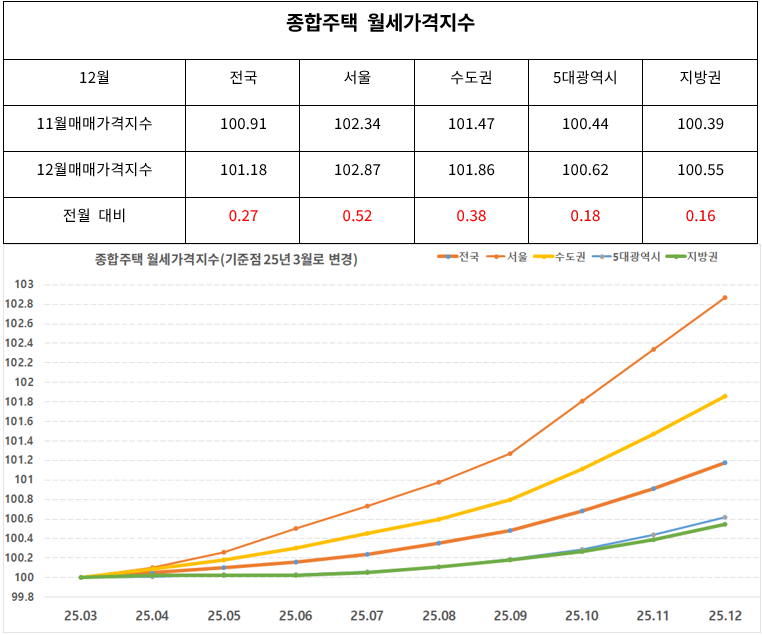
[Korea Real Estate Board, Month-on-Month Increase of %]
The national monthly rent price index in December 2025 rose by 0.271 TP3T compared to the previous month, slightly expanding the increase compared to the previous month.
Seoul's increase was 0.521 TP3T, the same as the previous month, while the Seoul metropolitan area saw a slight increase of 0.381 TP3T. The five metropolitan cities (+0.181 TP3T) and local regions (+0.161 TP3T) also saw slight increases compared to the previous month.In Seoul, rents continued to rise in areas with favorable living conditions, large complexes, and newly built properties, including Yangcheon-gu (+0.86%), Seocho-gu (+0.82%), Yeongdeungpo-gu (+0.80%), and Songpa-gu (+0.77%). In the metropolitan area, rents also rose in Suwon Yeongtong-gu (+1.04%), Seongnam Bundang-gu (+0.83%), Uiwang-si (0.66%), and Yongin Suji-gu (0.65%), mainly in preferred complexes and large complexes. Among the five metropolitan cities, Ulsan (+0.45%) and Sejong (+0.88%) showed the highest rate of increase, but Jeju (-0.12%) was the only one among the five metropolitan cities and the local areas to show a decline.
Due to regulations on jeonse loans, the preference for monthly rent over jeonse is intensifying among both landlords and tenants, and as the supply of jeonse properties gradually decreases, the preference for monthly rent is expected to continue for some time.
Comprehensive Analysis
In December 2025, the housing market maintained a moderate upward trend nationwide, but regional differences were evident. The national housing price index rose 0.261 TP3T from the previous month, marking the seventh consecutive month of increase. Seoul (0.801 TP3T) and the Seoul Capital Area (0.461 TP3T) saw notable increases, particularly in central Seoul. Metropolitan cities (0.091 TP3T) and regional areas (0.071 TP3T) also continued their moderate upward trend, suggesting that the upward momentum in the Seoul Capital Area is spreading to other regions.
The jeonse (long-term rental) market rose by 0.281 TP3T nationwide, marking the sixth consecutive month of growth. Seoul (0.531 TP3T) and the Seoul Capital Area (0.411 TP3T) as well as metropolitan cities (0.221 TP3T) and local areas (0.151 TP3T) continued to see growth. This growth appears to be due to the government's loan regulations and land transaction permit system, which have shifted some of the demand for sale to jeonse. The monthly rental market also rose by 0.271 TP3T nationwide, driven by increased demand for monthly rentals due to jeonse instability and loan regulations. In particular, the continued increase in monthly rental demand, particularly among small households, led the growth in Seoul (0.521 TP3T) and the Seoul Capital Area (0.381 TP3T).
Amid intense interest in whether the government will maintain the land transaction permit system or introduce additional measures, attention is focused on the future stabilization of housing prices and monthly rent.