
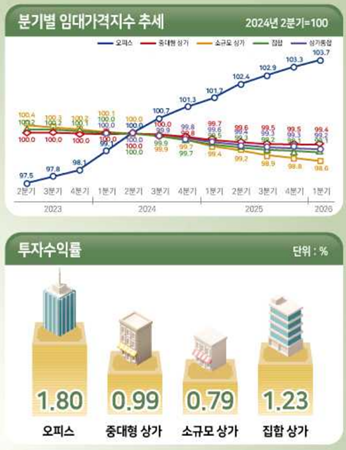
 In the first quarter of 2026, the South Korean commercial real estate market received a report card showing a clearer 'K-shape' than ever before. While the office market continued its winning streak with consecutive days of 'sunny' conditions, the retail market faced a particularly severe 'cold wave'.
While the office rental price index in Seoul's central business district trended upward, rising 0.341 TP3T from the previous quarter, the commercial property market bowed its head, declining 0.051 TP3T. In particular, small-scale commercial properties, a key indicator of neighborhood commercial districts, took a direct hit, plummeting by as much as 0.161 TP3T. What lies behind the office investment return recording 1.81 TP3T, achieving more than double the performance of commercial properties?
This peculiar temperature difference is clearly reflected in economic indicators as well. Thanks to strong exports and improved corporate performance, the Business Survey Index (BSI) rose to 94.9, approaching the normal level (100).
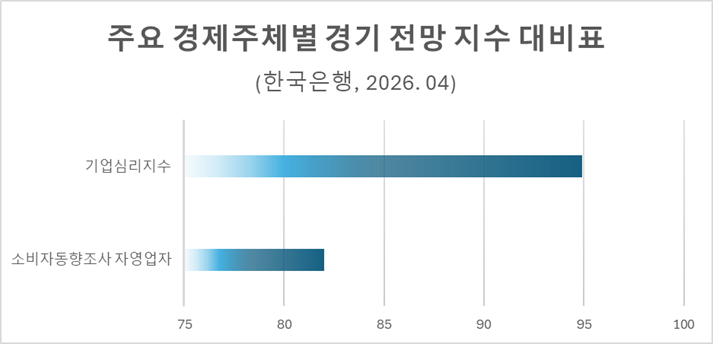 On the other hand, the living conditions index, which reflects the sentiment of the self-employed, received a dismal report card of 82. The so-called "decoupling" of economic sentiment—where corporations smile while the self-employed weep—is becoming more deeply entrenched, accelerating the polarization of the commercial real estate market.
Commercial Districts 'Stagnant' Despite Increased Consumption: Transforming into a 'Gateway' Platform for Money
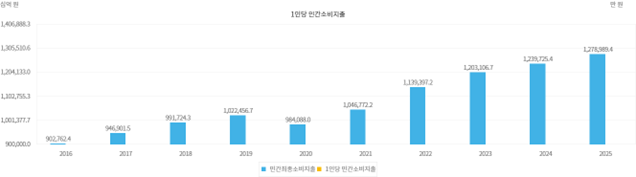
The saying that "business is bad because people aren't spending money" is now only half true. This is because actual consumption indicators are breaking all-time highs. Per capita private consumption expenditure continues to rise, and quarterly credit card spending has already entered the era of 300 trillion won. The problem lies in the "gateways" through which this massive amount of capital flows.
Data from the National Statistical Information Service (KOSIS) for March 2026 provides a clue to the answer. Online shopping transaction volume recorded 25.577 trillion won, a sharp increase of 13.31 trillion won compared to the same month of the previous year. A significant portion of consumption is being siphoned away from local commercial districts and toward "giant platforms" such as Coupang, delivery platforms, and large shopping complexes. In the past, increased consumption naturally led to bustling local restaurants and clothing stores, but now all payments are completed with a single finger on a smartphone. The era when profits were guaranteed simply by hanging a sign in a prime location has now vanished into the statistics.

The Charm Applied to a 'Promising Spot': The Power of Offline to Beat Online
Commercial districts that shine like gems amidst the fierce onslaught of online competition were by no means created by chance. They are "traditional strategic locations" where people of all generations gather due to convenient transportation, where a solid base of fixed demand is secured by the concentration of offices, and where foreign tourists naturally flow in.
Seongsu (Ttukseom), Gwanghwamun, Gangnam-daero, and Hongdae, which ranked at the top in investment returns in the second quarter of 2026, were already "meeting plazas" where people ate and had fun. As companies scrambled to set up showrooms, brand experience spaces, and pop-up stores in these "passages where people are bound to gather," adding physical appeal, the value of the commercial districts exploded.
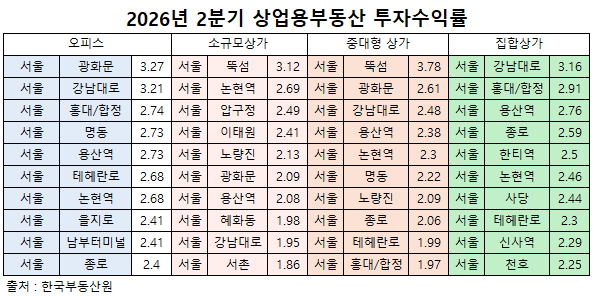
Especially holy water(Ttukseom)is the yield of medium to large commercial properties 3.78%Achieved an overwhelming result.. Sophisticated branding is applied to the rough space of the past. MZAttracting not only generations but also tourists ‘Irreplaceable place‘became. However, underlying that underlying strength are convenient transportation accessible from anywhere in Seoul and abundant nearby office demand..
Ultimately, the core is ‘War with online platforms‘It is a substantial competitive edge that can win.. Enough to overcome the overwhelming convenience of solving everything with just a flick of a finger, You must answer whether it is worth going all the way there.. The question is whether it is enjoyable and attractive enough to occupy people's time in a location with solid fixed demand and symbolic significance.. Only commercial districts that are already popular gathering places, enhanced with an overwhelming experience that online cannot provide, It is as if I am spending a hot summer all alone amidst the cold wave centered on this platform..
AI times, Polarization in the office market is intensifying further.

Until now, the office market was the only commercial real estate 'safe assets'has reigned as. As strong earnings from major companies coincided with limited supply of prime office,, This is thanks to the exceptional boom enjoyed, where vacancies are hard to find even amidst rising rents.. However, the office market is now also facing a massive paradigm shift, no less significant than the online shopping invasion that hit the self-employment sector..
The biggest threat is AI It is a change in the workforce structure due to development.AIAs it began to replace office work, The prevailing view is that the absolute size of physical space required by companies will decrease.. This is not a vague future.. Workforce reduction and organizational efficiency are already becoming a reality in some industries, and, A decrease in the workforce is highly likely to lead to a sharp decline in office demand..
To make matters worse, the office prices that had been propping up 'scarcity'Even is shaking.. This is because downtown business districts, where supply has been limited, are signaling an acceleration of large-scale supply due to deregulation and other factors.. A paradoxical situation where demand decreases while supply increases, In other words, a crisis comparable to the slump in the commercial real estate market has effectively reached the threshold of the office market..
Manage your appeal

Ultimately, whether it is commercial properties or offices, there are no eternal winners in the real estate market., There are no eternal losers.. Just as self-employed business owners stand at a crossroads of survival, pushed aside by platform power, The office market as well AIWe are facing a huge wave of technological advancement and supply expansion..
The important thing is to respond sensitively to changing paradigms without getting bogged down in the illusion of numbers.. In the future, as corporate workforces decrease, the physical area of offices itself may shrink.. However, the instinct of companies to secure top talent is rather 'An attractive space that makes you want to leave the house and go to work.'You will come to crave it even more..
Ultimately, all answers boil down to the essence.. Shopping centers are a physical experience that online cannot replace., Offices must prove their reason for existence by serving as prime locations where talented individuals willingly gather, even if the workforce shrinks.. Reading the paradigm shift hidden behind the numbers, ‘Value that attracts people on their own‘Only the place that manages this will be the ultimate winner in this era of great transformation..