<Buying and Selling

Although nationwide sales prices rose by 0.151 TP3T in March 2026, the nature of the market is closer to 'holding out' than 'rising'. The Seoul Metropolitan Area (0.271 TP3T) and Seoul (0.391 TP3T) led the rise, but this was a localized increase centered on certain preferred complexes rather than a result of active trading. In Seoul, areas based on actual demand such as Gwangjin-gu (0.911 TP3T), Seongbuk-gu (0.811 TP3T), and Seodaemun-gu (0.741 TP3T) led the increase, whereas Gangnam-gu (-0.391 TP3T) and Songpa-gu (-0.091 TP3T) declined despite expectations for reconstruction.
In Seoul, excluding Gangnam, the convergence of the rental crisis leading to a shift in demand from actual buyers to purchasing and the fatigue of buyers in prime locations resulted in a rotational buying trend centered on apartments priced below 1.5 billion won, leading to price increases. Conversely, the Gangnam area showed a downward trend due to the release of distressed sales ahead of the reinstatement of heavy capital gains taxes and stricter lending regulations.
In the Seoul metropolitan area as well, market direction remains unclear, with some regions of Gyeonggi Province showing a mix of rises and falls, while Incheon remains stable. Similarly, in the provinces, upward momentum is weak, with the exception of Ulsan (0.361 TP 3T) and Jeonbuk (0.251 TP 3T). Ultimately, the current sales market has shifted from a general upward phase to a 'differentiated market,' characterized by selective price increases driven by location amidst policy pressures and declining transactions.
<Jeonse
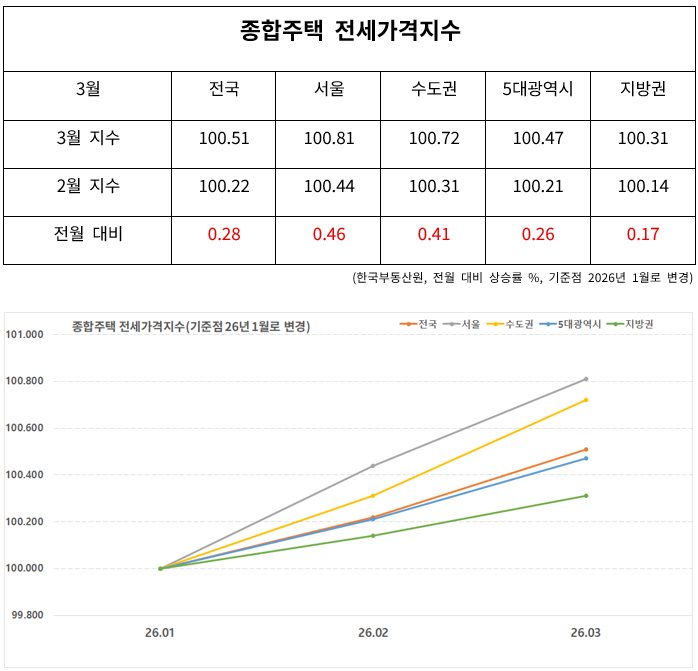
In March 2026, nationwide Jeonse prices rose by 0.281 TP3T, showing a distinctly stronger trend than sales prices. The Seoul Metropolitan Area (0.411 TP3T) and Seoul (0.461 TP3T) led the rise, while major provincial cities such as Sejong (0.601 TP3T), Ulsan (0.481 TP3T), and Busan (0.391 TP3T) also showed a clear upward trend. In Seoul, the increase is spreading not only to mid-to-low-priced residential areas like Seongbuk-gu (0.751 TP3T) and Nowon-gu (0.701 TP3T) but also to the Gangnam area including Seocho (0.481 TP3T) and Songpa (0.471 TP3T), resulting in a simultaneous rise across the entire region.
This is not merely a result of increased demand, but rather the accumulation of "remaining demand for Jeonse" due to the contraction of the sales market. As the transition to purchasing is delayed due to interest rate burdens and lending restrictions, rental demand remains in the market; simultaneously, supply is limited, particularly in new constructions and areas near subway stations, intensifying upward price pressure. The Jeonse market has already entered an upward phase one step ahead of the sales market, and it is highly likely to act as a key variable determining the market's direction depending on whether there is a future shift to purchasing.
<Monthly Rent >

In March 2026, nationwide monthly rent prices rose by 0.291 TP3T, confirming an overall upward trend in the rental market alongside Jeonse. Seoul (0.511 TP3T) and the Seoul Metropolitan Area (0.411 TP3T) led the rise, while provincial areas such as Ulsan (0.401 TP3T), Sejong (0.311 TP3T), and Jeonbuk (0.281 TP3T) also showed a simultaneous upward trend. In Seoul, a comprehensive rise is occurring across both Gangnam and Gangbuk, including Nowon-gu (0.991 TP3T), Gwangjin-gu (0.731 TP3T), Seongbuk-gu (0.721 TP3T), and Seocho-gu (0.741 TP3T).
This is directly linked to a structural change in which rising Jeonse prices and the increased burden of security deposits are shifting rental demand toward monthly rent. Particularly amidst the current interest rate environment, demand for monthly rent over security deposits is increasing, and landlords are reflecting this trend by simultaneously raising the proportion and prices of monthly rentals. Consequently, the monthly rent market is entering a phase of structural growth, establishing itself not merely as a short-term complement but as a key pillar replacing Jeonse.
<Comprehensive Analysis>

In March 2026, the housing market is exhibiting a structure where sales, Jeonse, and monthly rent are connected as a single flow rather than moving in different directions. While the sales market rose by only 0.151 TP3T as buyers and sellers remained in a wait-and-see mode ahead of the reinstatement of heavy capital gains taxes on multiple homeowners on May 9, Jeonse (0.281 TP3T) and monthly rent (0.291 TP3T) are continuing a distinct upward trend amidst supply and demand imbalances. This is the result of rental demand accumulating in the market as the shift to purchasing has been delayed due to interest rate burdens and loan regulations.
In particular, the rise in Jeonse prices is accelerating the shift to monthly rent, creating a structure that drives up prices across the entire rental market. Ultimately, within the current dual structure of "stagnant sales and rising rents," the timing of the shift toward purchasing is highly likely to act as a key variable determining the future direction of the market.