What makes the alleys that survive, nevertheless, different?
In Search of Surviving Alleys
In the article from the last April issue, we examined the formula for the rise and fall of Seoul's alley commercial districts through Garosu-gil and Gyeongnidan-gil. It is a paradox where unique small business owners, attracted by low rents, create the charm of the alley, that charm drives up rents, and the increased rents drive out the creators of that charm. The vacancy rate of 43.91 TP3T in Garosu-gil and the survival rate of 12.91 TP3T for restaurants in Gyeongnidan-gil coldly proved the results of that cycle.
If so, is this cycle an unavoidable fate? Are all up-and-coming alleys ultimately bound to cool down after passing through such a cycle? To answer this question, I intend to examine the sites of the two hottest areas in Seoul right now, the policy experiments aimed at institutionally preventing gentrification, and the more fundamental conditions that determine the fate of commercial districts.
Seongsu-dong – When an Old Factory Becomes a Brand
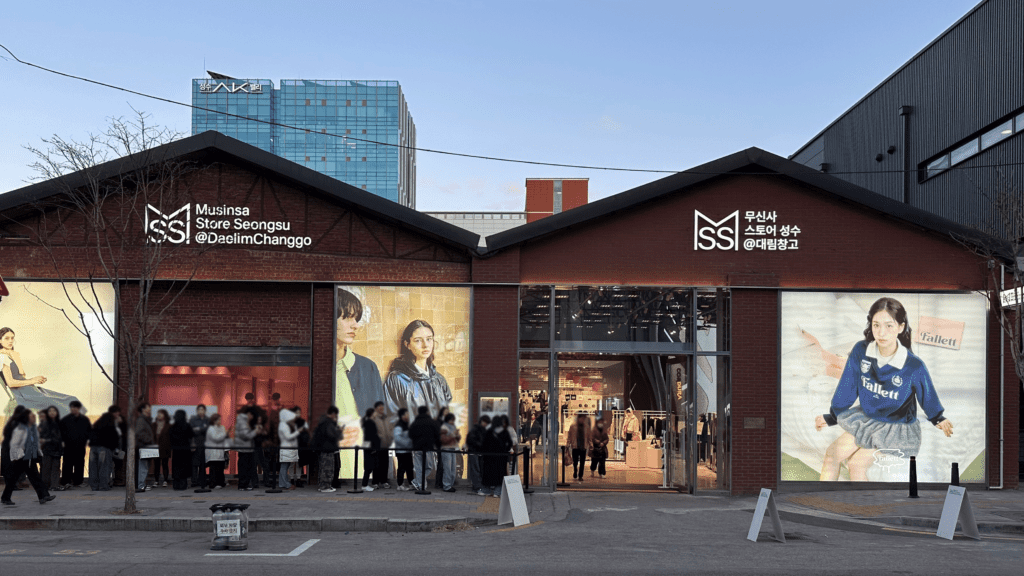
Seongsu-dong in Seongdong-gu was for a long time a semi-industrial area densely packed with handmade shoe workshops, printing presses, and small factories. In this neighborhood, where the noise of machinery and the smell of shoe polish were part of everyday life, cafes, galleries, and multi-cultural spaces began to spring up one by one starting in the mid-2010s, drawn by affordable rents and factory-style spaces with high ceilings. Up to this point, the trajectory is not much different from the early days of Garosu-gil or Gyeongnidan-gil.
However, what fundamentally distinguishes Seongsu-dong from other alley commercial districts is its scale. Since the 2020s, Seongsu-dong has become a key stage for global fashion, beauty, and IT brands to open pop-up stores. It has evolved from a mere cafe alley visited for coffee into an "offline marketing platform" where brands connect with consumers. Rents are skyrocketing, centered around Yeonmujang-gil, leading to concerns that it could become "the second Garosu-gil."
 However, Seongsu-dong possesses structural assets that Garosu-gil lacked. These include the unique physical texture of industrial heritage, the large-scale green infrastructure of Seoul Forest, and the formation of a resident population resulting from the relocation of corporate headquarters and IT and fashion companies. These factors are creating a complex commercial foundation that cannot be explained solely by demand for pop-ups and tourism. The key question determining Seongsu-dong's future is whether these structural assets can withstand the speed of rising rents, or whether it will follow the same path as Garosu-gil on an even larger scale.
However, there is one notable difference. While it was the "permanent entry" of franchises and global brands that drove up rents in Garosu-gil, it is the "short-term occupancy" of pop-up stores that is driving up rents in Seongsu-dong. If, from the landlord's perspective, pop-up tenants who pay higher unit prices for short-term leases are more attractive than long-term tenants, it becomes difficult for the long-term lease ecosystem—which supports the stability of the commercial district—to take root. In a sense, Seongsu-dong suffers from the same ailment as Garosu-gil, but the symptoms are manifesting in a different form.
Yeonnam-dong – Parks Boost Commercial Districts, Rent Tests Them
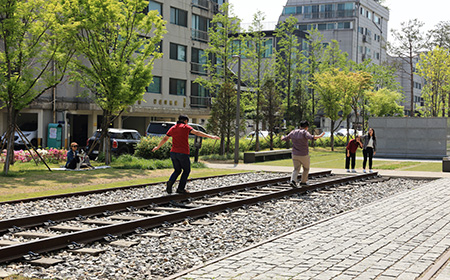
Yeonnam-dong in Mapo-gu is the clearest example of how public infrastructure investment changes the fate of a commercial district. Originally, it was nothing more than a quiet residential area adjacent to the Sinchon and Hongdae commercial districts. Everything changed when the Gyeongui Line was moved underground and a linear park was created on top of it.
Since the Gyeongui Line Forest Path opened in 2015, cafes, dessert shops, workshops, and bars have proliferated around the park, earning it the nickname 'Yeontral Park' (Yeonnam-dong + Central Park).

Entrepreneurs fleeing the high rents of the Hongdae commercial district formed the initial ecosystem of Yeonnam-dong. It gained explosive popularity as consumers sought to appreciate its unique residential alley vibe, walking paths harmonizing with parks, and photogenic spaces. However, Yeonnam-dong was not immune to this cycle. Rents along the main pathways near the park skyrocketed, and business diversity weakened due to an excessive concentration on the F&B sector. The conversion of residential properties into cafes and the decline of lifestyle service shops like laundromats and hair salons represented typical patterns of commercial gentrification.
The lesson from Yeonnam-dong is two-sided. While it is clear that the public investment in the "Gyeongui Line Forest Path" gave birth to a commercial district, it also revealed a structural problem where the benefits accrued first to building owners whose property values had risen, rather than to the citizens who created the walkable path. Yeonnam-dong demonstrated in real time just how quickly a path suitable for walking becomes an expensive one.
Experiments in Institutions – Can the Speed of the Circulation Be Slowed Down?

Attempts to institutionally slow down the cycle of rise and fall in alley commercial districts can also be found. A representative example is the amendment to the Commercial Building Lease Protection Act, which took effect on October 16, 2018. Through this amendment, the period for exercising a tenant's right to request contract renewal was extended from the existing 5 years to 10 years, and the annual rent increase limit was lowered from 91 TP3T to 51 TP3T. The intent is to buy time for tenants.
However, reactions in practice are mixed. With the introduction of the 10-year guarantee, landlords have shown a strong tendency to preemptively and significantly raise rents upon new contracts. While the law protects existing tenants, the threshold for new tenants has effectively become higher.

A more noteworthy experiment is Seongdong-gu's 'Sustainable Development Zone' system. Seongdong-gu, which enacted the nation's first related ordinance on September 24, 2015, and designated the area around Seoul Forest-gil as a Sustainable Development Zone, restricted the entry of large corporate franchises and encouraged 'win-win agreements' between building owners and tenants. In 2023, the zone was expanded 8.6 times to cover the entire Seongsu-dong area, and a method was introduced to provide incentives for easing floor area ratios on the condition that an agreement to stabilize rent is signed for the new construction or expansion of buildings.
There are figures demonstrating the effectiveness of this system. The average operating period for businesses participating in the mutual growth agreement was 79 months, compared to 52 months for non-participating businesses, showing a difference of approximately 27 months. 27 months, or about two years, is a critical period for small business owners to stabilize their businesses and secure regular customers.
The data showing that Seongdong-gu's mutual growth agreement extended the survival period of commercial tenants by 27 months is certainly encouraging. However, to be frank, this merely slowed the 'speed' of collapse slightly; it is difficult to view it as a result that shifted the market's 'direction' itself. If so, what are the conditions to change the direction rather than the speed, and the structure rather than the system?
The Strength of a Commercial District – 'Visiting Commercial Districts' and 'Embracing Commercial Districts'

I would like to call this the 'strength of a commercial district.' The key is intrinsic consumption demand, that is, the presence or absence of underlying demand.
Consider Gyeongnidan-gil, Garosu-gil, or Yeonnam-dong during its heyday. The common thread among these commercial districts is that they are places consumers must "go out of their way to visit." Their structure relies entirely on external influx for their survival. When a place becomes a hot topic on social media, crowds flock in explosively, but once the hype fades, foot traffic ceases. Since rents are fixed based on peak performance, a decline in foot traffic immediately leads to vacancies. This is the inherent vulnerability of "commercial districts that require a special visit."
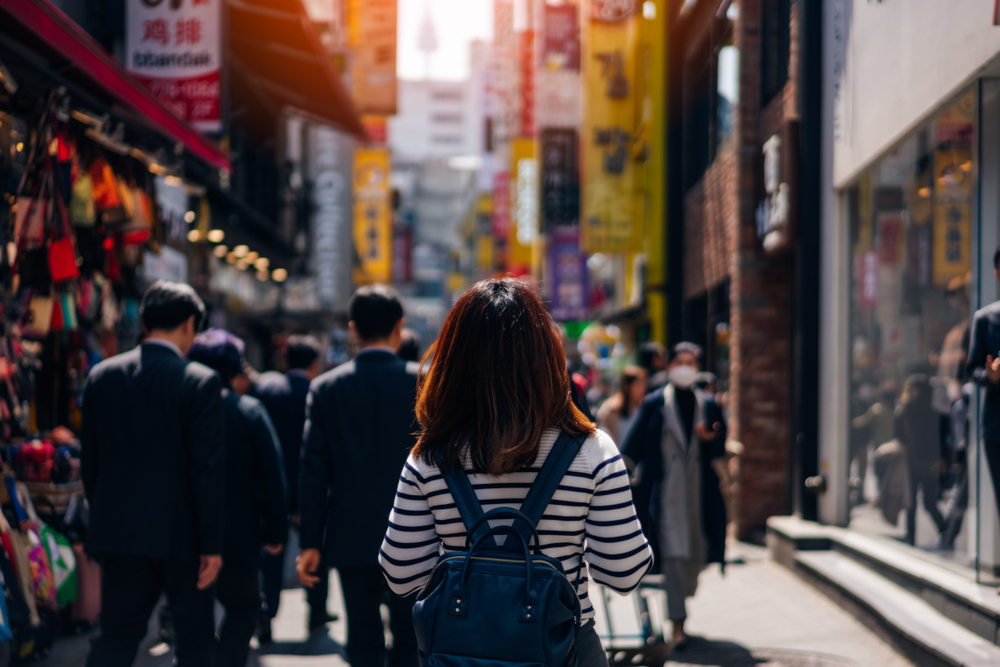
On the other hand, the alleys of Euljiro and Mugyo-dong, which I walk through every day, have a different structure. Located in the heart of the CBD (Central Business District), this area harbors a massive consumer demand from tens of thousands of office workers residing in high-end office buildings. Long before the name 'Hipjiro' was coined, and even after the buzz surrounding that name faded, these people walk through these alleys every day to have lunch and schedule dinner appointments. Because this underlying demand firmly supports the foundation of the commercial district, the amplitude of fluctuations is small, and the speed of recovery is rapid.
In fact, as I discussed in a previous article, the office vacancy rates in the core CBD areas of Gwanghwamun, City Hall, Euljiro, and Jongno showed a consistent downward trend from the first quarter of 2022 to the first quarter of 2024 (Korea Real Estate Institute). Gwanghwamun fell from 7.91 TP3T to 4.01 TP3T, and Jongno from 11.01 TP3T to 4.11 TP3T. This is the exact opposite trajectory to that of Garosu-gil, where the commercial vacancy rate soared from 36.51 TP3T to 43.91 TP3T during the same period. When offices are filled with people, the alleys are filled with people as well. Vacancies in commercial facilities and offices are not separate issues, but rather two sides of the same coin.
In my article "There Is No Era of Vacancies," published in the February 2026 issue of the Remax Journal, I argued that "location" must become "destination." Now, I would like to add one more point. For a commercial district to be truly sustainable, it is insufficient to be merely a "destination sought after from the outside." That destination must be supported by a "location that harbors consumer demand" in itself. When the appeal of the destination combines with the resilience of the location, the alley becomes a commercial district that is not swayed by trends.
Leaving the Mugyo-dong alley

The fact that Garosu-gil is emptying out and Gyeongnidan-gil is cooling down is not solely due to the economic downturn. It is because the unique stories of the alleys have disappeared due to rising rents, and there is no underlying demand to replace them.
From this perspective, I take a new look at the alleys of Mugyo-dong and Dadong. There is the Seoul-style loach soup at Yonggeumok, which has guarded Mugyo-dong for 93 years, and a plate of seasoned lamb tripe at Buminok, which is 70 years old. These long-standing establishments have endured the test of time not only because of the passage of years, but also because they have accumulated their own unique stories and flavors. However, that is not the whole story. The more fundamental reason these alleys remain vibrant is that the footsteps of tens of thousands of people pouring out daily from the offices of the CBD—the forefront of South Korean capital—support the very foundation of these streets. When the power of stories meets the stamina of demand, the alley transcends trends and triumphs over time.
The role of commercial real estate experts must be redefined here. Rather than chasing "where is trending," we must read "when the self-sustainability of a commercial district begins to be undermined by rent." Furthermore, it involves diagnosing whether the strength of the consumer demand harbored by an alley is in balance with its unique story. Designing the sustainability of a commercial district beyond mere brokerage—that is the direction the true profession required of us today should be heading.