2025.9 complex housing price index
[Trading]
Note
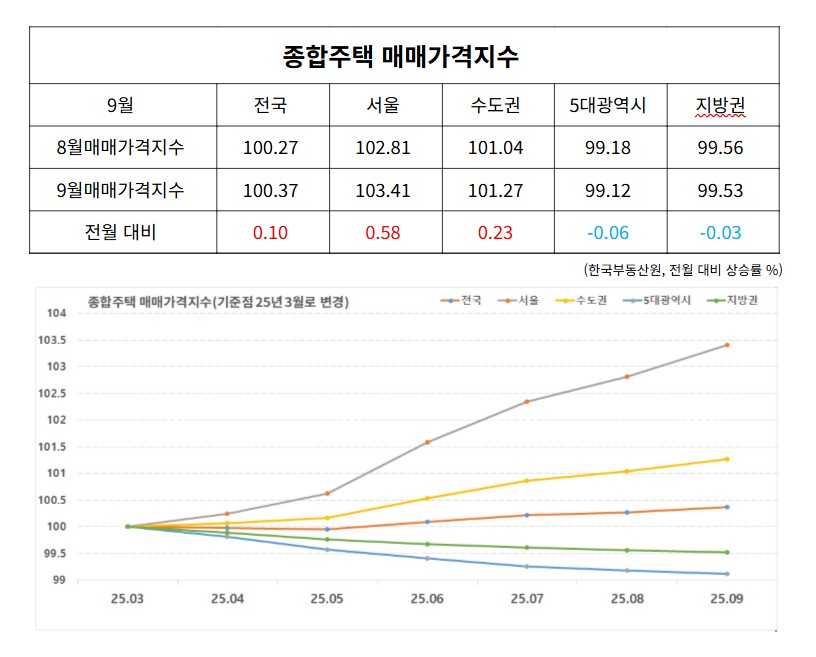
The national housing price index rose 0.101 TP3T in September 2025 compared to the previous month, continuing its upward trend for six consecutive months. Seoul, in particular, saw a 0.581 TP3T increase, significantly exceeding the national average. Buyers continued to flock to redevelopment complexes and large complexes near subway stations. Notably, Songpa-gu (+1.301 TP3T), Yongsan-gu (+1.201 TP3T), and Seongdong-gu (+1.491 TP3T) saw strong sales growth.
Gangnam-gu (+0.71%) showed strength, centered on areas with excellent school districts and living infrastructure. The Seoul Metropolitan Area saw a slight increase, with a 0.23% increase. Bundang-gu (+0.98%), Gwacheon-si (+0.83%), and Anyang-donggu (+0.72%) led the gains. Conversely, the five major metropolitan cities continued to decline, with prices falling by -0.06%, and local areas by -0.03%. Daegu (-0.19%), Daejeon (-0.12%), and Jeju (-0.14%) showed weakness due to increased supply and sluggish transactions. Ulsan (+0.09%), Sejong (+0.15%), and North Jeolla Province (+0.07%) maintained limited gains.
Since the government's June 29 and September real estate measures, the real estate index has been steadily rising, centered around Seoul and the metropolitan area, while the local region continues to show a polarized trend of weakness.
[charter]
Note
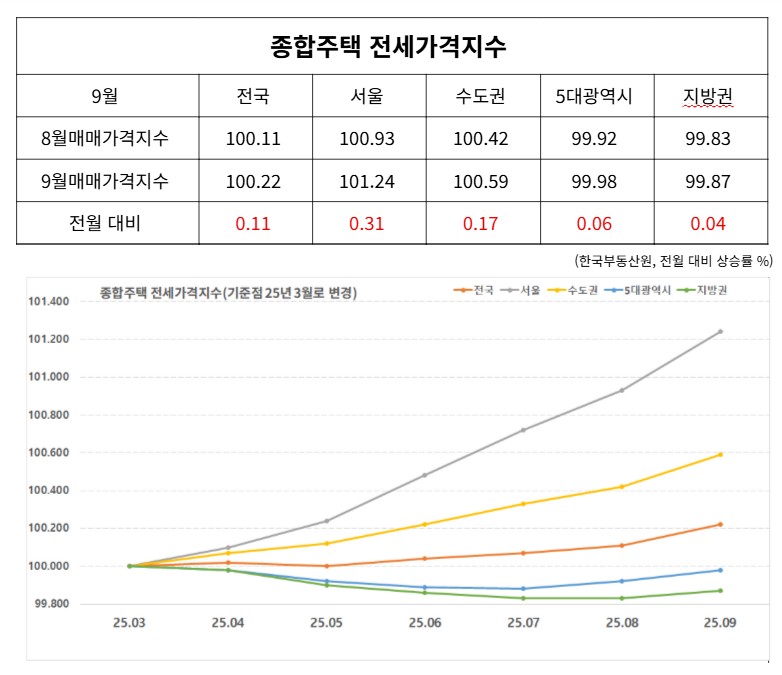
The national rental price index rose 0.111 TP3T in September 2025 compared to the previous month, marking the fourth consecutive month of moderate growth. Seoul's rise of 0.311 TP3T exceeded the national average, driven by demand concentrated in areas near subway stations, new construction, and school districts. The increase was particularly pronounced in desirable complexes such as Songpa-gu (+0.951 TP3T), Gangdong-gu (+0.571 TP3T), Yongsan-gu (+0.541 TP3T), and Yeongdeungpo-gu (+0.451 TP3T).
The Seoul metropolitan area saw a 0.171 TP3T increase, with continued strength centered on large-scale apartment complexes near subway stations, such as Hanam (+0.681 TP3T), Gwacheon (+0.681 TP3T), and Anyang Dongan (+0.591 TP3T). The five major metropolitan cities saw a 0.061 TP3T increase, while local areas saw a 0.041 TP3T increase compared to the previous month. Ulsan (+0.201 TP3T) and Sejong (+0.311 TP3T) maintained their upward trend, while Daejeon (-0.131 TP3T), Daegu (-0.061 TP3T), and Jeju (-0.151 TP3T) continued to weaken.
The rental price index, like the sale price index, continues to be concentrated in the metropolitan area, while the recovery trend in local areas is limited due to the burden of the number of new occupants.
[monthly rent]

Note
The national monthly rent price index for September 2025 rose by 0.131 t/3T month-on-month, expanding from the previous month's 0.111 t/3T. Seoul recorded 0.291 t/3T, the Seoul Capital Area 0.201 t/3T, the five major metropolitan cities 0.081 t/3T, and other regions 0.071 t/3T, showing a stable or higher trend across all regions. With the continued preference for monthly rent over jeonse (long-term lease), the upward trend was particularly pronounced in areas with favorable living conditions, such as Songpa-gu (+0.731 t/3T), Yongsan-gu (+0.631 t/3T), Seongdong-gu (+0.351 t/3T), and Yeongdeungpo-gu (+0.481 t/3T).
In the metropolitan area, rental conversions were active, particularly in officetels and small and medium-sized apartments, such as in Gwacheon (+0.401 TP3T), Anyang Dongan (+0.251 TP3T), and Hanam (+0.191 TP3T). In other regions, Ulsan (+0.291 TP3T), North Chungcheong (+0.101 TP3T), and Busan (+0.091 TP3T) showed increases, while Jeju (-0.151 TP3T), Daegu (-0.071 TP3T), and Daejeon (-0.071 TP3T) showed decreases. This structural shift is occurring due to continued restrictions on jeonse loan financing and jeonse instability, with demand for rental conversions, particularly among young people and single-person households, continuing to increase.
<synthesis analyze>
In September 2025, the housing market maintained a moderate upward trend nationwide, but regional differences emerged. The national housing price index rose 0.101 TP3T month-on-month, marking the sixth consecutive month of gains. Seoul (0.581 TP3T) and the Seoul Capital Area (0.231 TP3T) saw increases, centered on redevelopment projects and areas near subway stations. Conversely, regional markets (-0.031 TP3T) continued to weaken due to increased occupancy and sluggish transactions, continuing a polarized trend where recovery in Seoul and the Seoul Capital Area coexisted with declines in regional markets.
The rental market rose nationwide by 0.111 TP3T, marking the fourth consecutive month of growth. The concentration of rental housing in favored areas, particularly Seoul (0.311 TP3T) and the Seoul Capital Area (0.171 TP3T), intensified. While large-scale apartment complexes near subway stations, such as Hanam, Gwacheon, and Songpa, saw notable increases, regional markets, such as Daegu, Daejeon, and Jeju, continued to decline.
The monthly rental market also rose nationwide by 0.131 TP3T, driven by increased demand for monthly rentals due to jeonse instability and loan regulations. In particular, Seoul (0.291 TP3T) and the Seoul Capital Area (0.201 TP3T) led the increase, driven by increased demand from young people and single-person households.
Overall, the September market was a period of simultaneous recovery centered on the metropolitan area, where expectations for reconstruction and excellent living conditions were high, an acceleration of the transition to monthly rent due to jeonse instability, and a decline in transactions in local areas.
This trend is expected to be a key variable determining whether the overall market recovery will spread, depending on future interest rate fluctuations and policy directions. Furthermore, attention is focused on the impact of the government's real estate policy announced on October 15th on each index.