2025.5 Comprehensive Housing Price Index
Note
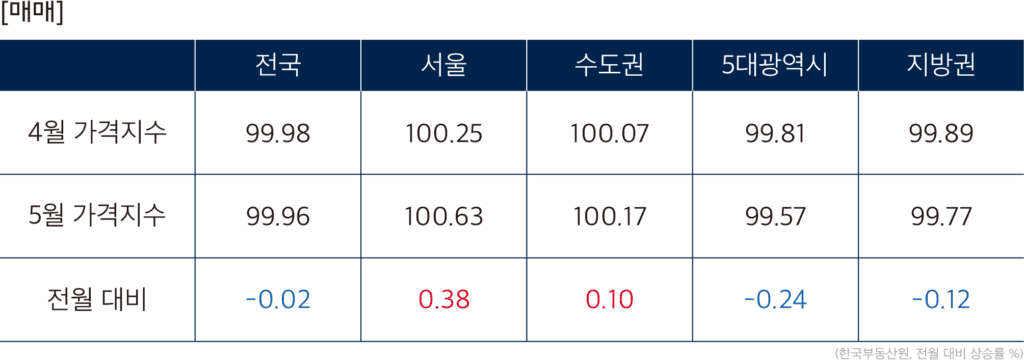
The Comprehensive Housing Price Index (CPI) increased in Seoul (0.38%) compared to the previous month, and the Seoul Metropolitan Area (0.10%) also saw a slight increase. However, due to a higher rate of decline in local areas, the index ended with slight fluctuations nationwide (-0.02%). Compared to the previous month, the number of rising areas decreased (from 67 to 63), the number of stagnant areas decreased (from 3 to 2), and the number of declining areas increased (from 108 to 113), showing a similar range of fluctuations to the previous month. In Seoul, the upward trend continued, centered on preferred complexes, with increases centered on Seocho, Songpa, and Gangnam districts, expanding the overall increase in Seoul. Incheon saw declines centered on Yeonsu, Gyeyang, and Dong districts, while Gyeonggi Province continued to see declines centered on Pyeongtaek, Goyang Ilsandong-gu, and Anseong.
In Seoul, in Gangbuk (0.23%), prices rose mainly in major complexes in Seongsu and Geumho-dong in Seongdong-gu (0.65%), in Ichon-dong and the Hangangno area in Yongsan-gu (0.62%), in semi-new construction in Yeomri and Ahyeon-dong in Mapo-gu (0.62%), and in Gwangjin-gu (0.30%) mainly in Gwangjang and Jayang-dong. In Gangnam (0.53%), prices rose mainly in Banpo and Jamwon-dong in Seocho-gu (0.95%), in Jamsil and Sincheon-dong in Songpa-gu (0.92%), and in Apgujeong and Daechi-dong in Gangnam-gu (0.84%). In Incheon (-0.07%), the overall price decline closed lower, with Yeonsu-gu (-0.36%) leading the decline, driven primarily by the influx of new housing in Songdo and Okryeon-dong, and Gyeyang-gu (-0.10%), led by the decline in Gyesan and Hyosung-dong. In Gyeonggi (-0.05%), despite a significant rise in Gwacheon-si (1.20%), the price closed slightly lower, with declines in Pyeongtaek-si (-0.56%), Goyang Ilsandong-gu (-0.43%), and Anseong-si (-0.38%).

Note
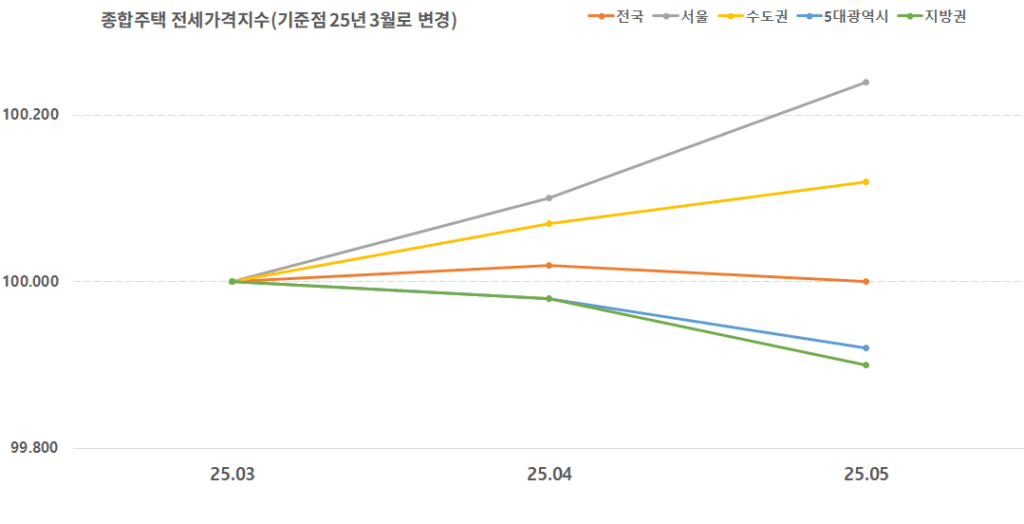
The jeonse price index rose slightly in Seoul (0.141 TP3T) and the Seoul Capital Area (0.051 TP3T), while remaining flat or slightly declining in the five major metropolitan areas, ending the month with a slight decline nationwide (-0.021 TP3T). Compared to the previous month, the number of rising areas decreased (from 99 to 94), the number of stagnant areas remained flat (from 4 to 4), and the number of declining areas increased (from 75 to 80), marking a shift from rising to declining. In Seoul, rental demand remained steady and rising contracts were signed in preferred complexes with favorable living conditions, such as those near subway stations, school districts, and large-scale complexes, expanding the overall increase in Seoul. Incheon saw a decline, primarily in Yeonsu and Seo-gu, due to the influx of new housing units. In Gyeonggi Province, prices rose, primarily in Gwacheon, Anyang's Dongan-gu, and Yongin's Suji-gu.
In Gangbuk-gu (0.12%) in Seoul, prices in Gangbuk-gu (-0.05%) fell mainly in Suyu-dong and Mia-dong, while prices in Yongsan-gu (0.23%) rose mainly in major complexes in Dowon-dong and Itaewon-dong, Nowon-gu (0.17%) rose mainly in areas near subway stations in Junggye-dong and Gongneung-dong, and Mapo-gu (0.16%) rose mainly in Yeomri-dong and Ahyeon-dong. In Gangnam-gu (0.17%), prices in Seocho-gu (-0.14%) fell mainly in Jamwon-dong and Seocho-dong, but prices in Gangdong-gu (0.42%) rose mainly in new construction in Godeok-dong and Dunchon-dong, ending the day with an overall increase. Among the five metropolitan cities, Daejeon saw the largest declines in Yuseong-gu (-0.641 TP3T) and Jung-gu (-0.261 TP3T). Daegu (-0.131 TP3T) saw the largest declines in Dalseong-gun (-0.261 TP3T) and Buk-gu (-0.231 TP3T). Among other regional regions, Jeju (-0.161 TP3T) saw a decline, primarily in small-scale properties in Seogwipo and Jeju-si. Gangwon-do (-0.131 TP3T) saw a decline, primarily in Sokcho-si and Wonju-si, which are affected by the influx of new housing.

Note
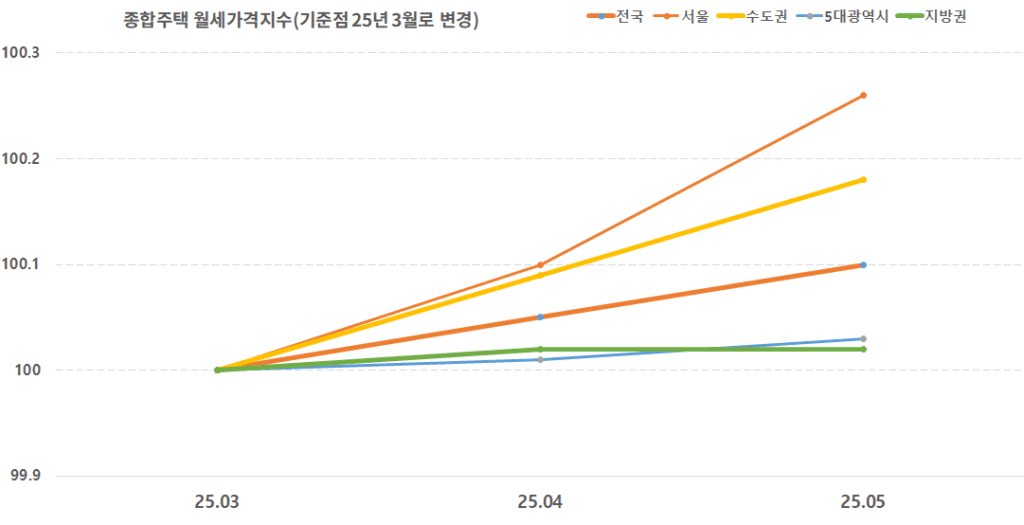
The monthly rent price index rose nationwide by 0.051 t/3T, remaining flat compared to the previous month. Seoul (0.161 t/3T) saw a larger increase due to the continued preference for monthly rent amid the economic downturn and loan regulations. Within the Seoul Capital Area (0.091 t/3T), Incheon saw a decline, led by Seo-gu, but a rise, led by Gyeyang, Namdong, and Jung-gu. Gyeonggi saw a decline, led by Pyeongtaek and Gimpo, but a rise, led by Gwacheon, Seongnam, Sujeong-gu, and Gwangju, leading to an overall increase. Among the five major metropolitan cities, Daegu saw a decline, led by Buk and Jung-gu, but Ulsan saw a rise, led by Buk and Nam-gu, and Gwangju saw a rise, led by Nam and Buk-gu. Consequently, the five major metropolitan cities shifted from flat to rising. Conversely, other regions saw a sustained increase in North Chungcheong Province, a sustained decrease in Jeju, a wider decline in South Chungcheong Province, and a shift from rising to falling in Gangwon Province. Overall, the index shifted from rising to falling.
After the land transaction permit system was redesignated at the district level, the transaction volume and sale price index of the upper-tier districts of Gangnam, Seocho, Songpa, and Yongsan are on an upward trend again, while the sale price index of local areas is continuously falling. Therefore, it seems that it is time to deeply consider the effectiveness of the land transaction permit system again.