<Trading>
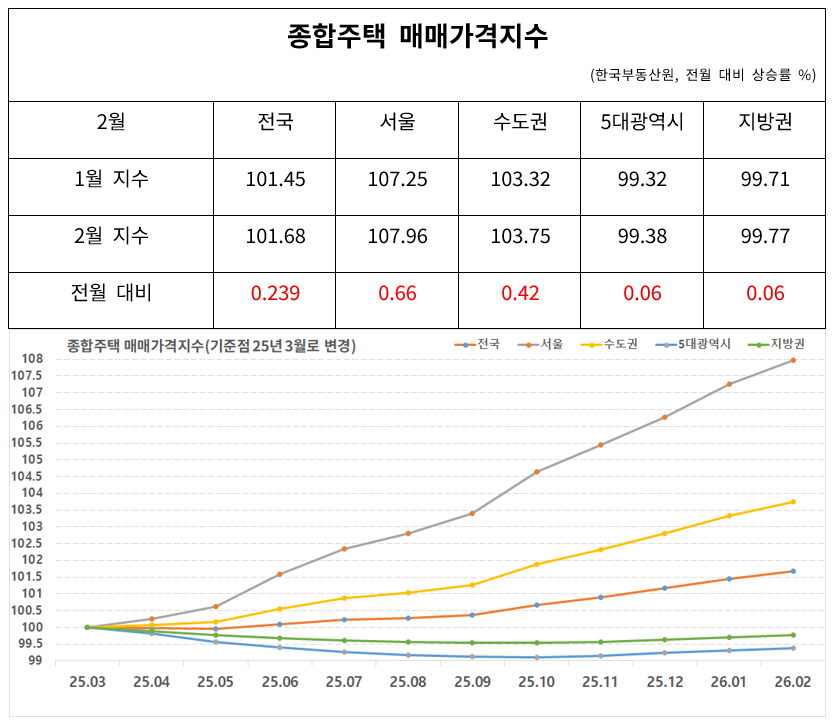
In February 2026, the nationwide housing sales price index maintained a moderate upward trend, rising 0.231 TP3T from the previous month. The Seoul metropolitan area led the market with a 0.421 TP3T increase, significantly outpacing the national average, while provincial areas showed a relatively weak trend, rising only 0.061 TP3T.
Seoul recorded the highest rate of increase at 0.661 TP3T, influenced by continued rising transactions centered on preferred areas despite a wait-and-see attitude emerging as declining listings appeared in some complexes.
Gyeonggi rose by 0.361 TP3T, but there was a wide disparity between regions, with some areas such as Icheon (-0.351 TP3T) and Pyeongtaek (-0.261 TP3T) declining due to the impact of new housing supply, while Yongin Suji-gu (2.361 TP3T) and Guri-si (1.771 TP3T) saw significant increases. Incheon showed a near-flat trend at 0.041 TP3T, with a mix of increases in some areas such as Yeonsu-gu (0.471 TP3T) and decreases in Seo-gu (-0.121 TP3T) and Gyeyang-gu (-0.101 TP3T).
In the provinces, Ulsan (0.381 TP3T), Busan (0.121 TP3T), and Jeonbuk (0.241 TP3T) rose, but Jeju (-0.141 TP3T) declined, resulting in an overall limited rise. Overall, we are in a phase where an upward trend centered on the Seoul metropolitan area and a selective recovery trend in the provinces are appearing simultaneously.
<The World>
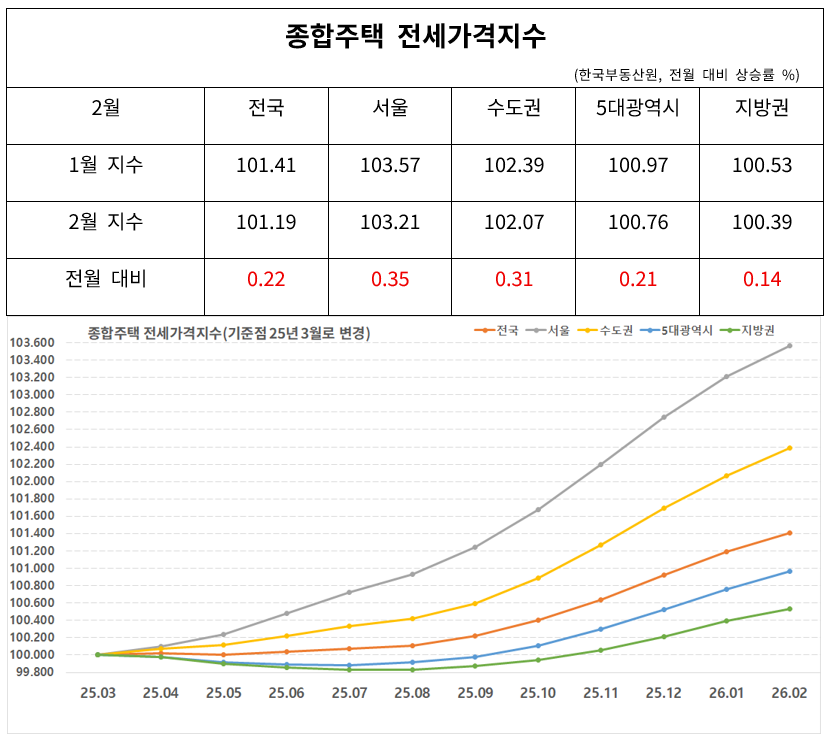
In February 2026, the nationwide Jeonse price index rose by 0.221 TP3T compared to the previous month, continuing a stable upward trend. The increase was larger in the Seoul metropolitan area at 0.311 TP3T, while the rise in provincial areas was limited to 0.141 TP3T.
Seoul rose by 0.351 TP3T; although declines were observed in some complexes, the upward trend continued as demand remained centered on large complexes and areas with excellent living conditions. The rise was notable in major areas such as Nowon-gu (0.821 TP3T), Seongdong-gu (0.701 TP3T), and Seocho-gu (0.691 TP3T).
Gyeonggi rose by 0.341 TP3T, showing strong gains in Hwaseong Dongtan (1.281 TP3T), Suwon Yeongtong (0.951 TP3T), and Yongin Suji (0.921 TP3T), while Incheon rose by 0.151 TP3T, with Yeonsu-gu (0.391 TP3T) and Namdong-gu (0.201 TP3T) leading the rise.
In regional areas as well, the number of rising regions (155) significantly exceeded the number of falling regions (25), maintaining an overall upward trend. While Ulsan (0.391 TP3T), Busan (0.341 TP3T), and Jeonbuk (0.241 TP3T) saw increases, Jeju (-0.141 TP3T) showed a downward trend. Amidst supply and demand imbalances, the Jeonse market continues a generally stable upward phase, despite regional differences.
Monthly rent
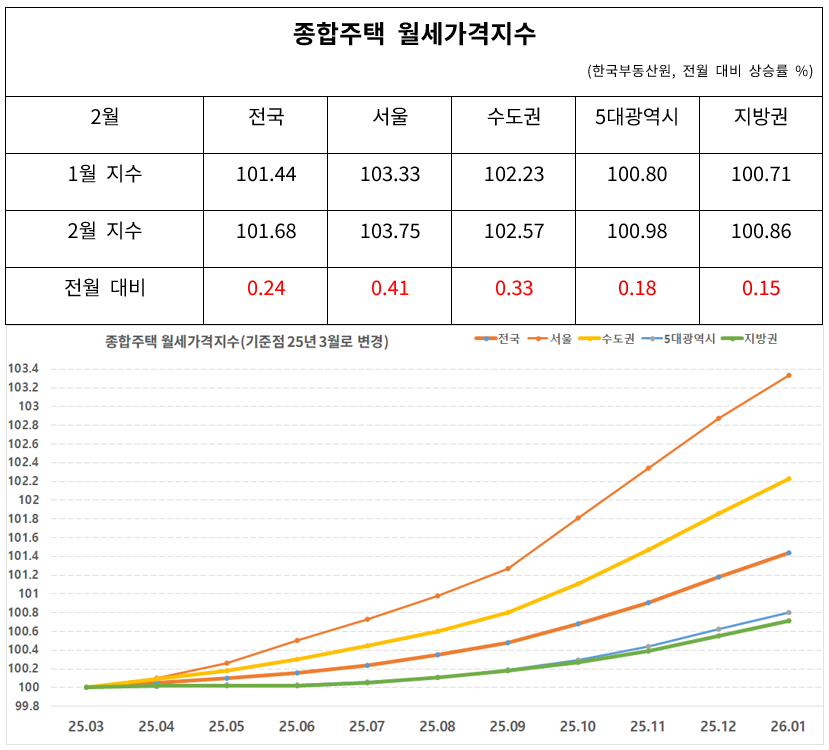
In February 2026, the nationwide monthly rent price index rose by 0.241 TP3T compared to the previous month, recording a higher growth rate than sales (0.231 TP3T) and Jeonse (0.221 TP3T). The Seoul metropolitan area showed a strong upward trend with a rise of 0.331 TP3T, while provincial areas were relatively moderate with a rise of 0.151 TP3T. Seoul saw a rise of 0.411 TP3T, largely driven by increased demand for monthly rent centered on properties near subway stations and near-new construction. In particular, upward pressure persists as demand for converting to monthly rent expands due to the burden of Jeonse prices and a decrease in Jeonse supply.
Gyeonggi rose by 0.311 TP3T, with the upward trend continuing centered on major areas such as Seongnam Bundang and Hwaseong Dongtan. Incheon rose by 0.231 TP3T, with increases driven by station areas in Dong-gu and small to medium-sized homes in Namdong-gu.
In regional areas, Ulsan (0.391 TP3T), Sejong (0.331 TP3T), Busan (0.261 TP3T), and Gyeongnam (0.221 TP3T) led the rise, while Jeju (-0.141 TP3T) showed a downward trend. Overall, the monthly rent market is assessed as maintaining the most robust upward trend, driven by a combination of increasing rental demand and the shift from Jeonse to monthly rent.
Comprehensive Analysis

In February 2026, the national housing market showed an overall recovery trend with increases in sales (0.231 TP3T), Jeonse (0.221 TP3T), and monthly rent (0.241 TP3T), but the center of the rise is still concentrated in the metropolitan area.
Seoul, in particular, continues its upward trend, but the momentum behind rising sales prices appears to be gradually slowing recently. This is due to an increase in listings resulting from the current government's loan regulations and tax policies, particularly the expiration of the grace period for heavy capital gains taxes on multiple homeowners. However, as the increased supply is not being absorbed quickly by the market, transactions are stagnating, and in some areas, a wait-and-see attitude is expanding, weakening the upward momentum.
On the other hand, the Jeonse and monthly rent markets maintain a relatively steady trend based on rental demand, and the structure is such that upward pressure on the monthly rent market is becoming more pronounced as the shift to monthly rent accelerates due to the burden of Jeonse.