11Monthly Real Estate Journal
Comprehensive Housing Sales Price Index
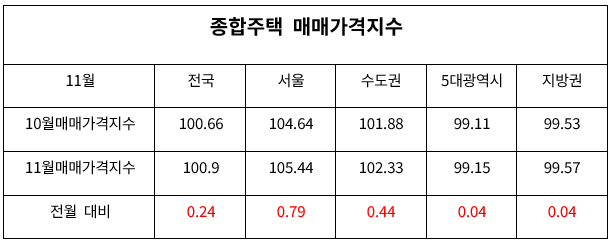
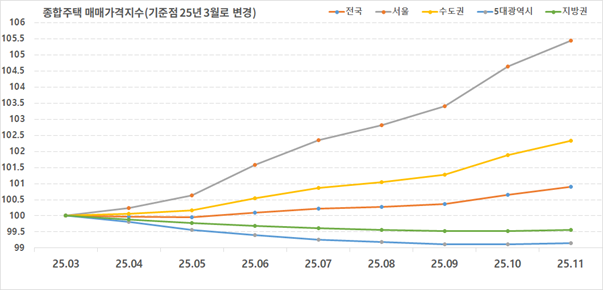
The national housing price index rose 0.241 tpa3t in November 2025 compared to the previous month, continuing its upward trend for six consecutive months. Seoul, in particular, saw a 0.791 tpa3t increase, significantly exceeding the national average. Buying pressure continued to flow into redevelopment projects, areas near subway stations, and large complexes. The number of areas experiencing increases compared to the previous month increased to 114, while the number of areas experiencing decreases decreased significantly to 63.
In particular, Songpa-gu (+2.101 TP3T), Yongsan-gu (+1.371 TP3T), Seongdong-gu (+1.371 TP3T), and Dongjak-gu (+1.461 TP3T) showed high growth rates, with areas with excellent convenience and living infrastructure showing strong performance. The Seoul Metropolitan Area saw a larger increase, with a 0.441 TP3T increase, while Bundang-gu (+1.991 TP3T) and Gwacheon-si (+1.551 TP3T) led the increase, driven by expectations of redevelopment projects.
Driven by the Seoul metropolitan area, the five major metropolitan cities also saw a 0.041 TP3T increase, while regional areas also saw a 0.041 TP3T increase. Among metropolitan cities, Ulsan (0.371 TP3T) saw the highest increase, while among regional areas, Jeollabuk-do (0.251 TP3T) saw the largest increase. However, Daegu (-0.121 TP3T), with its unsold inventory remaining unresolved, continued to show a downward trend.
As the government's continued measures have led to a blockage in lending, transaction volumes are decreasing, and attention is focused on future housing prices.
Comprehensive Housing Lease Price Index

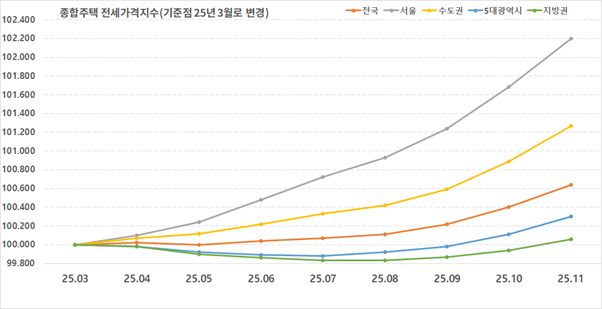
The national rental price index in November 2025 rose 0.24% from the previous month, recording a gradual increase for six consecutive months.
Seoul rose by 0.511 TP3T, significantly exceeding the national average. Rental demand continued to rise in areas with favorable living conditions, such as Seocho-gu (+1.241 TP3T), Songpa-gu (+1.201 TP3T), Yangcheon-gu (+0.821 TP3T), and Yeongdeungpo-gu (+0.711 TP3T), and in preferred complexes such as school districts and subway stations.
The Seoul metropolitan area also saw a 0.381 TP3T increase, outpacing the national average. The increase was particularly notable in complexes with favorable living conditions, such as Hanam (+1.431 TP3T), Suwon Yeongtong-gu (1.411 TP3T), and Seongnam Bundang-gu (1.031 TP3T). The five major metropolitan cities saw a 0.191 TP3T increase, while regional areas saw a significant increase of 0.121 TP3T compared to the previous month. Sejong (+1.451 TP3T) led the way in regional areas, and Ulsan (0.351 TP3T) in metropolitan cities. However, Jeju (-0.121 TP3T) and Gangwon (-0.051 TP3T) continued to weaken.
The rental price index, like the sale price index, continues to be concentrated in the metropolitan area, while the recovery trend in local areas is limited due to the burden of the number of new occupants.
Comprehensive Housing Monthly Rent Price Index
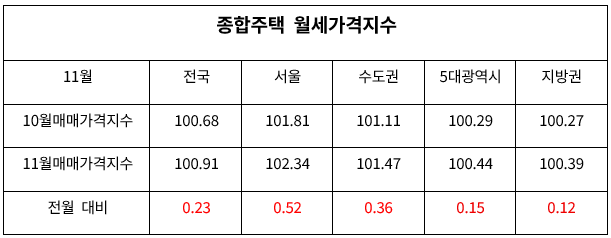
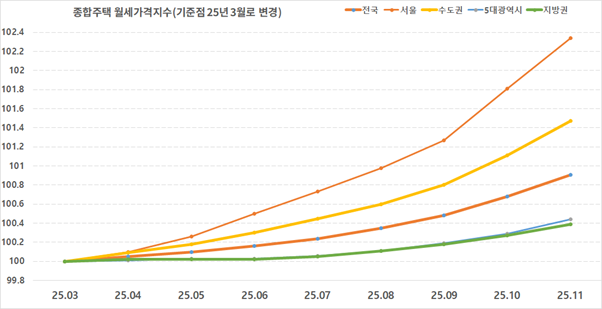
The national monthly rent price index for November 2025 rose by 0.231 TP3T compared to the previous month, slightly expanding from the previous month. Seoul saw the largest increases, at 0.521 TP3T, and the Seoul Capital Area at 0.351 TP3T. The five major metropolitan cities (+0.151 TP3T) and local areas (+0.121 TP3T) also saw larger increases compared to the previous month.
In Seoul, monthly rent demand continued to rise, mainly in small and medium-sized complexes near subway stations and in complexes with good living conditions, such as Songpa-gu (+1.07%), Yongsan-gu (+0.92%), Yeongdeungpo-gu (+0.86%), and Yangcheon-gu (+0.83%). In the metropolitan area, the rate of increase was high in Bundang-gu, Seongnam (+1.01%), Guri-si (+0.91%), and Yeongtong-gu, Suwon (0.89%). Among the five metropolitan cities, Ulsan (+0.36%) and Sejong (+0.66%) showed the highest growth rates among the provinces, but Jeju (-0.14%) was the only one among the five metropolitan cities and provinces to show a decline.
The continued shortage of jeonse properties, coupled with changes in the interest rate environment, strengthened taxation, and tighter lending regulations, is exacerbating the trend of both landlords and tenants preferring monthly rent over jeonse.
<Comprehensive Analysis>

In November 2025, the housing market maintained a gentle upward trend nationwide, but regional differences were evident. The national housing sales price index rose 0.24% from the previous month, continuing its upward trend for the seventh consecutive month. Seoul (+0.79%) and the metropolitan area (+0.44%) showed an upward trend, centered on redevelopment projects and preferred complexes.
However, since the government's lending restrictions, the volume of housing transactions has declined exponentially, widening the gap between supply and demand. Both metropolitan cities (+0.041 TP3T) and regional areas (+0.041 TP3T) have also reversed their downward trend and turned upward, indicating that the upward momentum in the metropolitan area is spreading to regional areas.
The rental market rose for the sixth consecutive month, rising by 0.241 TP3T nationwide. The increase was not only greater in Seoul (+0.511 TP3T) and the metropolitan area (+0.381 TP3T), but also in metropolitan cities (+0.191 TP3T) and local areas (+0.121 TP3T). As the government tightens regulations on housing loan purchases, some of the demand for purchases appears to have shifted to jeonse (long-term rental) options. The monthly rental market also saw a nationwide increase of 0.231 TP3T, driven by increased demand for monthly rentals due to jeonse uncertainty and loan regulations. In particular, as monthly rent demand, particularly from young people and single-person households, continued to increase, Seoul (+0.52%) and the metropolitan area (+0.36%) led the upward trend.
The stability of housing sales prices and the monthly rent market will likely depend on the government's decision to maintain the land transaction permit system and the direction of additional measures. For the time being, market trends will need to be closely monitored, as lending regulations and changes in rental demand intersect.