(This content is for general informational purposes only. Please consult a tax professional for actual application.)
Introduction

In South Korea, for a corporation to own a house is tantamount to a declaration that it will accept punitive taxes. With a flat surcharge of 121 TP3T in acquisition tax, the application of the highest comprehensive real estate tax rate (up to 51 TP3T), and an additional surcharge of 201 TP3T added to the corporate tax upon transfer, the government is thoroughly blocking corporate 'investment plays' in the housing market.
However, even within these formidable walls of regulation, there is a legal 'door' left open for the normal economic activities of companies and the welfare of workers: the acquisition and ownership of housing to ensure housing stability for employees.
I hope this article, which introduces an 'employee housing portfolio' that enables companies to fully enjoy capital gains while providing housing benefits to employees, will offer readers new insights into corporate real estate investment.
I also believe that this insight, coupled with the market outlook where housing prices are expected to fall due to a massive release of properties by multi-home owners, could present a significant opportunity for corporations.
Definition of 'Employee Housing'

Although the term 'employee housing' is commonly used, an examination of actual tax law provisions reveals that different requirements apply depending on the purpose of each tax category (local or national tax). These requirements are summarized in the table below.
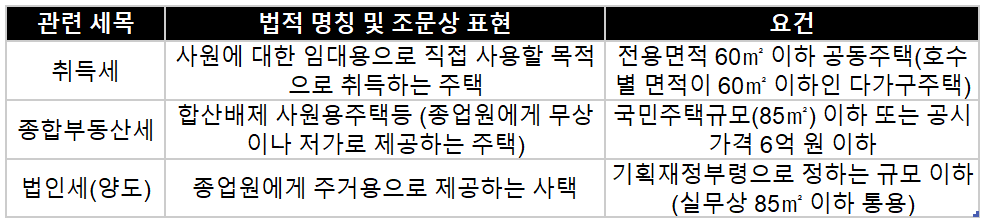
"Employee housing" is not a single proper noun but a general concept referring to "housing of a certain size or smaller provided to general employees who are not controlling shareholders or executives (company housing)." As the area and value criteria differ at each stage of acquisition, holding, and transfer as described above, one must identify the intersection that satisfies all these requirements and target that to receive all tax benefits.
Tax benefits on the acquisition, ownership, and transfer of employee housing

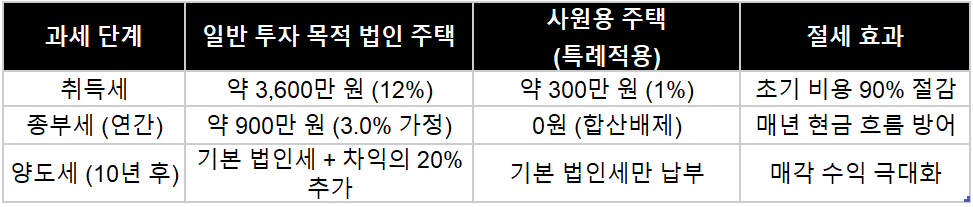
If a corporation purchases a house with an exclusive area of 60㎡ (approx. 18 pyeong) and an officially assessed value of 600 million won or less and provides it to an employee as housing (including for a fee, provided it is lower than the market price), there are the following benefits regarding acquisition tax, comprehensive real estate tax, and corporate tax (upon transfer).
■ Acquisition Stage: 12% Exclusion from Heavy Taxation
When a corporation acquires a house, a flat tax rate of 121 TP3T applies; however, when a corporation acquires a house with an exclusive area of 60㎡ or less for the purpose of leasing to employees, a general tax rate of 11 TP3T to 31 TP3T applies. This allows for a significant reduction in initial capital expenditure.
■ Holding Stage: Exclusion from Aggregation for Comprehensive Real Estate Tax (Tax-Exempt)
For housing owned by a corporation, a single maximum tax rate (up to 51 TP3 T) is applied to the entire value without a basic deduction, but for housing used by employees, if an application for exclusion from aggregation is made, the Comprehensive Real Estate Tax is not levied on that housing. Even if one owns many houses, the Comprehensive Real Estate Tax is zero as long as the requirements are met.
■ Transfer Phase: Exemption from additional Corporate Tax of 20%
When a corporation sells a house, it must pay an additional 20% on the capital gains as 'capital gains from land, etc.' in addition to the basic corporate tax; however, if the house is sold after being used as company housing for 10 years or more, this additional 20% tax rate is exempted. This allows capital gains accumulated over 10 years to be attributed to the company without the application of additional tax rates.
Application Example (60 of 300 million won㎡ (Housing Standards)
Precautions and Post-Care Guidelines

Since the tax benefits are substantial and generous, there are naturally additional requirements. Post-management by tax authorities is also very strict, so caution is required. Because a single violation of requirements can cause previously exempted taxes to return like a bomb along with penalties, business owners must strictly control and manage the following matters.
■ Prohibition of residence by executives and major shareholders If the CEO, their relatives, executives, major shareholders, etc., reside in the relevant housing or move their address therefor even for a single day, the special exemption for employee housing will be immediately revoked, and the full amount of taxes may be collected.
■ Strict adherence to the statutory retention (use) period
Acquisition tax: The benefit must be used for employee use within one year of acquisition, and if it is sold or used for other purposes before three years of employee use, the difference of 12% will be collected.
Comprehensive Real Estate Tax: If the use of the property is changed or it is sold within 5 years of the application of the exclusion from aggregation, the exempted comprehensive real estate tax may be collected.
Capital Gains Tax: The benefit is granted only if the employee housing is used for more than 10 years.
conclusion
 In the current housing rental market, many predict that monthly rent and deposit prices will rise, and furthermore, the availability of rental housing itself will decrease. In this era of housing instability, companies providing affordable and stable housing to their employees will contribute to attracting talent and ensuring long-term employment more than high salaries. The employee housing described in this article aims to minimize the cost burden of acquiring and maintaining housing, which serves as a driving force for attracting and retaining such excellent personnel.
Due to the current government's tax pressure and lending regulations on multi-home owners, small properties are flooding the market, and this situation is expected to worsen. This presents an opportunity for insightful and prepared companies. Furthermore, if companies purchase properties from multi-home owners and supply them as housing for young people, it would be welcome news for the government as well.
Could an asset growth cycle involving “acquiring affordable, high-quality assets, minimizing asset maintenance costs, and cashing out through sales without additional taxation” be a way for key talent and the companies they work for to grow together?