◼ The Changing Map of Commercial Districts and Real Estate Due to the 'K-Tourism Boom'
Seoul Megacity has entered the era of 20 million annual foreign tourists for the first time in history, standing shoulder to shoulder with world-class major tourist cities such as Paris, France, Tokyo, Japan, and Hong Kong. This is analyzed as the result of the combination of advanced public transportation infrastructure, thorough public safety, and global favorability toward K-POP and K-content.
This massive 'K-tourism craze' is transcending a cultural phenomenon and causing unprecedented tectonic shifts in the map of Seoul's commercial districts. The investment compass of real estate investors and the asset management industry also appears to be rapidly shifting from the 'travel routes of office workers' to the 'travel routes of foreign tourists.'
◼ Entering the Top Ranks of World-Class Tourist Cities… Seoul Enters the Era of 20 Million Annual Inbound Tourists

The change in Seoul's status is also proven by objective global indicators. For the first time in history, Seoul has been named to the 'Top 10 Most Attractive Travel Destinations in the World's 100 Cities' selected by CNN and the global market research firm Euromonitor International.
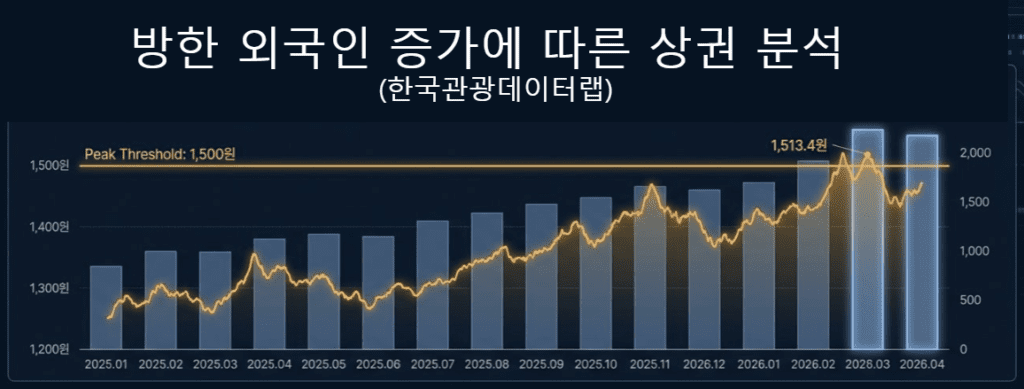
Unlike in the past, when the number of foreign visitors to Korea hovered around the 15 million mark, recent macroeconomic charts show that the high won-dollar exchange rate exceeding 1,500 won has provided a powerful boost to price competitiveness. Buoyed by this, the city experienced an unprecedented boom, surpassing 2 million monthly visitors for two consecutive months in March (2,045,992) and April (2,027,860) of this year, and has firmly established itself as a super-powerful megacity with an annual capacity of 20 million visitors. As it transforms into one of the world's few top-tier tourism powerhouses, the value of Seoul's commercial real estate market is also soaring.
 <Source: Real Estate Institute>
◼ Common characteristics of top-ranking commercial districts for rent and yield… “Internal and external demand, tourists”
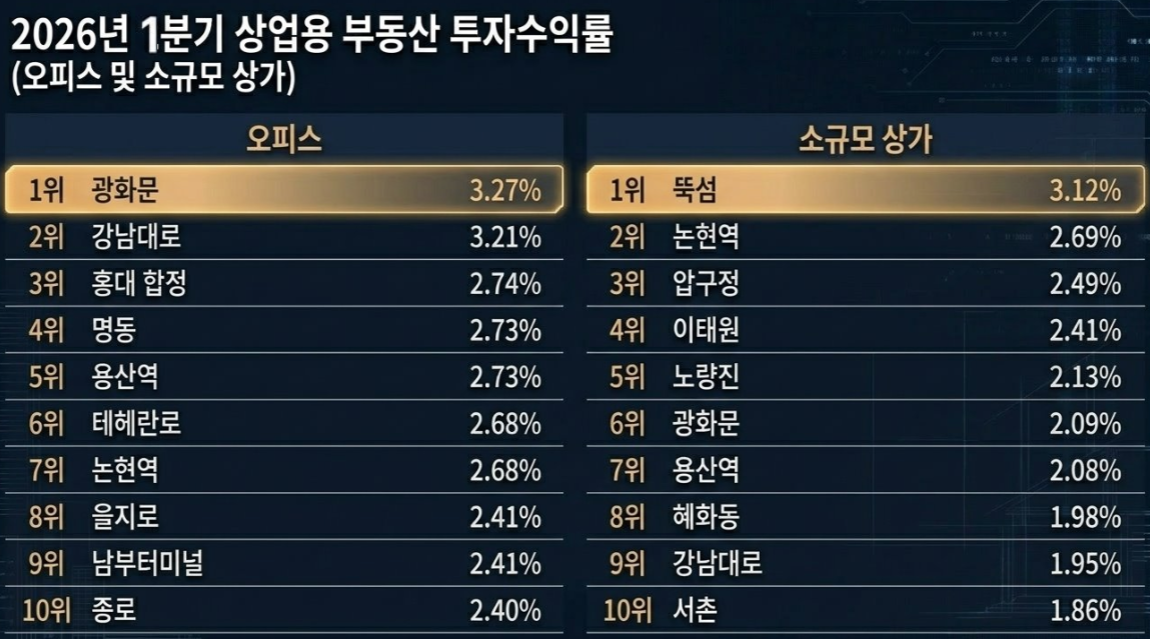
An interesting commonality can be found by closely examining the rankings of rental rates for small commercial districts and the top investment return areas in Seoul based on the Korea Real Estate Institute’s Q1 2026 Commercial Real Estate Rental Market Trends data. The formula is that the most expensive and profitable top-tier commercial districts in Seoul are now, without exception, "popular commercial districts and tourist destinations that attract both domestic and foreign tourists."
 <Source: Real Estate Institute>
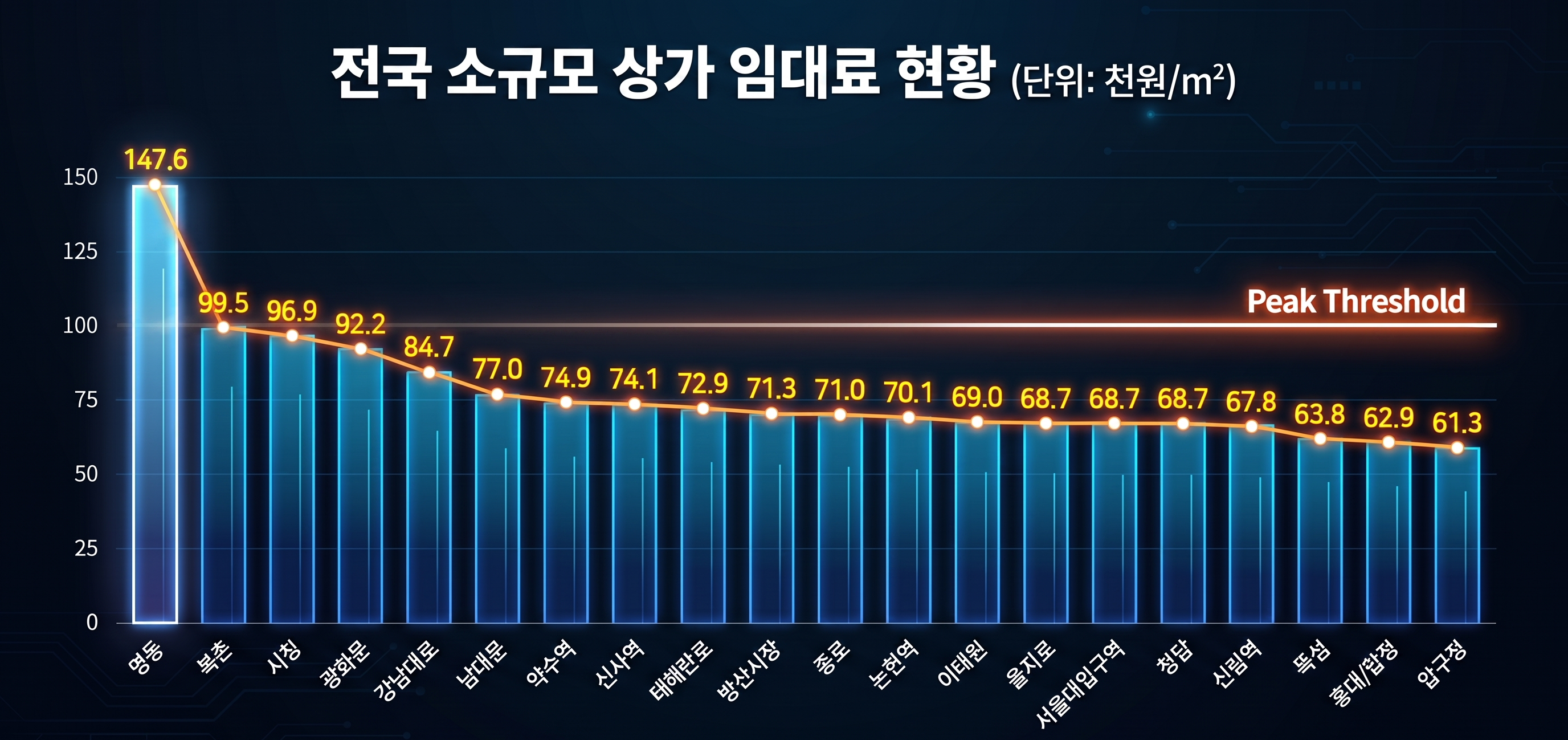
In the past, proximity to subway stations and the "office demand" from employees of large corporations commuting to and from work were the benchmarks for the best commercial districts. However, looking at the current rental rates for small commercial properties nationwide, Myeongdong, which ranks first as a preferred destination for foreigners (19.11 TP3T), maintains its top position with a rental rate of 147,600 won per square meter, leaving traditional office districts such as Gangnam-daero (84,700 won) and Teheran-ro (72,900 won) far behind by an overwhelming margin.
The same is true for the newly emerging Seongsu-dong (Ttukseom). As soon as foreign preference surged explosively by 3.41 TP3 Tp in one year and rose to second place (7.21 TP3 T), the Ttukseom commercial district took first place in all of Seoul in both the small-scale (3.121 TP3 T) and medium-to-large-scale (3.781 TP3 T) categories in the commercial real estate investment return data for the second quarter of this year.
The moment it becomes famous as a trendy restaurant and pop-up store and a 'holy site for proof shots' for foreign tourists, people pour in 365 days a year regardless of the day or time, creating a virtuous cycle that naturally leads to rising rent and asset values.
 <Source: Real Estate Institute>
◼ Domestic demand alone cannot sustain it… Seoul commercial districts surpass the limits of their value
Experts coolly diagnose this phenomenon, stating that it is because "domestic demand alone has reached a critical point where it is no longer possible to support the excessively high valuations of Seoul's commercial districts."
With the contribution of domestic consumption sluggish due to the economic downturn and high inflation, "domestic-only commercial districts" that rely solely on lunch and dinner sales from office workers five days a week are bound to face fatal obstacles such as weekend vacancies and nighttime hollowing. On the other hand, foreign tourists visiting Korea, who possess strong global purchasing power despite high exchange rates, blur the boundaries between weekdays and weekends. As they fill nearby F&B (food and beverage) establishments and open their wallets for street shop shopping (preference 58.2%), they are driving the trickle-down effect of the entire commercial district.
 Furthermore, significant changes are also occurring in the downtown building sales market. In line with the overwhelming growth of independent travelers (FIT, 75.51 TP3T), "small and medium-sized building value-add" investments—which involve purchasing vacant offices or aging buildings in the city center and remodeling them into small hotels or hostels—are considered the only breakthrough for the commercial real estate market. In fact, the number of tourism accommodation businesses nationwide has been on an upward trend for five consecutive years, reaching 2,731; among them, the hostel business has surged by a whopping 621 TP3T, rising from 728 in 2019 to 1,180 currently.
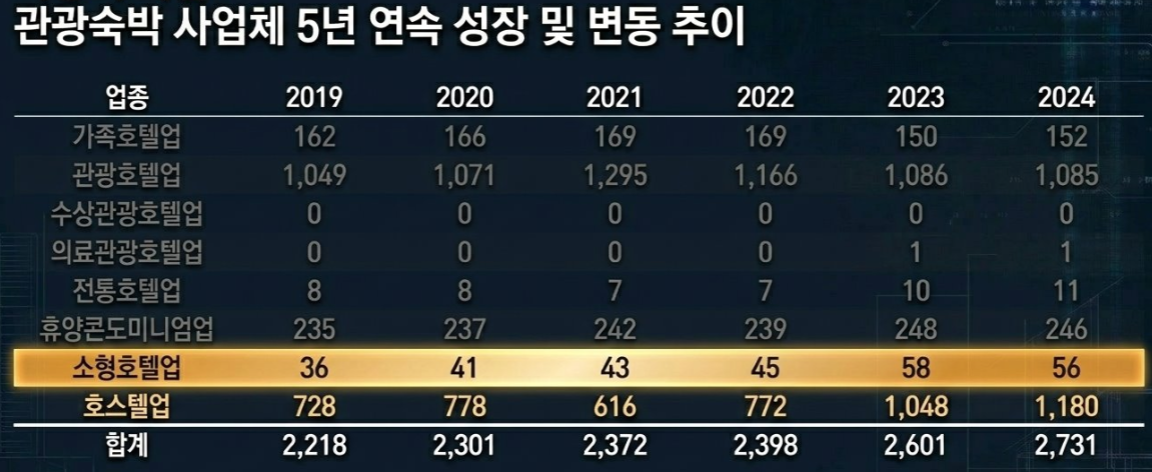 <Source: Korea Tourism Data Lab>
◼ 'Tourist Attraction Power' Surpassing Office and Residential Demand Directs to a Building's Value
Ultimately, investment in Seoul's commercial real estate must now move beyond simplistic analyses that merely check the catchment area or the movement patterns of office workers. Success or failure of an investment is determined by whether it possesses attractive content and infrastructure that draw domestic and international tourists—in other words, "expandability as a tourist destination."

An official from a real estate asset management company emphasized, “Like Paris, France, or Tokyo, Japan, Seoul has become a major tourism hub where global capital converges,” adding, “We have entered an era centered on ‘global tourism commercial districts,’ where a business must go beyond office and residential demand and absorb the demand from foreign tourists like a sponge to be recognized as a proper commercial area and increase its value.”