2025.1 Comprehensive Housing Price Index

Note
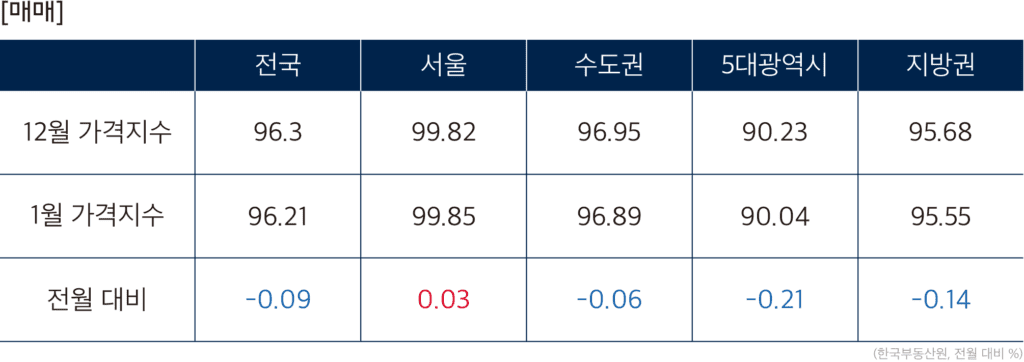
The Comprehensive Housing Price Index rose slightly only in Seoul (0.03%), while it declined in the Seoul Capital Area (-0.06%), the five major metropolitan cities (-0.21%), and local areas (-0.14%). Compared to the previous month, the number of rising areas decreased (from 59 to 45), the number of flat areas decreased (from 3 to 0), and the number of falling areas increased (from 116 to 133), ending the month with a nationwide decline. In Seoul, prices declined primarily in Nowon-gu, Guro-gu, and Dongjak-gu, but rose primarily in Songpa-gu, Yongsan-gu, and Seocho-gu. This mixed trend continued across each complex and region, with the rate of increase slowing compared to the previous month. In Incheon, prices continued to decline, centered around Namdong-gu, Gyeyang-gu, and Yeonsu-gu. In Gyeonggi Province, prices declined in Pyeongtaek and Gwangmyeong, affected by supply, leading to a shift from flat to falling prices.
In Seoul, the Gangbuk area (0.02%) saw a decline centered around Sanggye-dong/Hagye-dong in Nowon-gu (-0.09%), and in Dobong-gu (-0.04%) centered around Banghak-dong/Chang-dong. However, Yongsan-gu (0.17%) saw a rise centered around Ichon-dong and Hannam-dong, Gwangjin-gu (0.14%) centered around Gwangjang-dong/Jayang-dong with good living conditions, and Seongdong-gu (0.1%) centered around major complexes in Geumho-dong/Seongsu-dong. In Gangnam (0.05%), the decline was led by the construction of Guro-dong/Gaebong-dong in Guro-gu (-0.07%) and Sadang-dong/Heukseok-dong in Dongjak-gu (-0.04%), but the rise was led by the construction of small and medium-sized complexes in Jamsil-dong/Sincheon-dong in Songpa-gu (0.22%) and preferred complexes in Banpo-dong/Seocho-dong in Seocho-gu (0.15%). In Incheon (-0.23%), Namdong-gu (-0.42%) saw a decline mainly due to construction in Mansu-dong/Ganseok-dong, Gyeyang-gu (-0.41%) saw a decline mainly due to construction in Hyoseong-dong/Jakjeon-dong, which is affected by an increase in unsold properties, and Yeonsu-gu (-0.33%) saw a decline mainly due to Dongchun-dong/Yeonsu-dong. In the Gyeonggi area, Anyang-si Dongan-gu (0.31%) saw a rise mainly due to expectations of reconstruction in Pyeongchon-dong/Hogye-dong, and Gwacheon-si (-0.23%) saw a rise mainly due to ongoing reconstruction projects in Byeoryang-dong/Burim-dong. However, Pyeongtaek-si (-0.47) saw a decline mainly due to construction in Dongsak-dong/Bijon-dong, which is affected by the supply, and Gwangmyeong-si (-0.42%) saw a decline mainly due to construction in Hayan-dong/Cheolsan-dong, turning to a decline compared to the previous month.


Note
The jeonse price index continued to rise in 2024, but has been flat or slightly declining nationwide since January of this year. Compared to the previous month, the number of rising areas decreased (from 101 to 87), the number of flat areas increased (from 2 to 7), and the number of declining areas increased (from 75 to 84). Seoul saw an uptrend centered around popular complexes, but declines in some outlying areas and in established neighborhoods, leading to a mixed trend across regions, shifting from overall growth to a flat trend. In Incheon, the decline was particularly pronounced in Jung-gu and Seo-gu due to the impact of new housing units. In Gyeonggi Province, increases were primarily seen in Ilsanseo-gu in Goyang City and Giheung-gu in Yongin City.
In Seoul, in the Gangbuk area (0.00%), prices rose mainly in Sindang-dong/Jungnim-dong in Jung-gu (0.08%) and in the area around Hagye-dong/Junggye-dong in Nowon-gu (0.07%), but in Dongdaemun-gu (-0.,18%), prices fell mainly in Jangan-dong/Jeonong-dong due to the influence of new housing, in Seongdong-gu (-0.17%), prices fell mainly in Haengdang-dong/Eungbong-dong, and in Mapo-gu (-0.06%), prices fell mainly in Daeheung-dong/Ahyeon-dong, and the overall region closed in a flat trend. In Gangnam (0.01%), prices fell mainly in Bongcheon-dong and Namhyeon-dong in Gwanak-gu (-0.11%), and in Gangdong-gu (-0.08%), prices fell mainly in Gail-dong and Dunchon-dong. However, prices rose mainly in small and medium-sized properties in Garak-dong and Jamsil-dong in Songpa-gu (0.11%), and in Banpo-dong and Yangjae-dong in Seocho-gu (0.08%). This appears to be due to increased restrictions on jeonse loans, which have recently led to an increase in demand for conversions from jeonse to monthly rent.


Note
The monthly rent price index rose slightly from the previous month, rising 0.091 t/3T. Seoul maintained its upward trend, driven by continued demand for monthly rent in preferred complexes with favorable living conditions. Incheon saw increases primarily in areas near subway stations in Namdong-gu and in preferred complexes in Michuhol-gu. Gyeonggi saw increases primarily in redevelopment complexes in Gwacheon and new construction in Suwon's Yeongtong-gu. Daegu saw declines primarily in Jung-gu and Suseong-gu, but increases primarily in Ulsan's Ulju-gun and Dong-gu districts, broadening the increase across the five major metropolitan cities. Among other regional areas, Jeju saw a wider decline, but Gyeongnam and Gangwon regions saw increases, leading to nationwide increases in eight provinces.
In the case of sales, the further increase in sales prices appears limited as transaction volume has fallen to less than half of the level in the second half of last year due to the still existing price gap between sellers and buyers. However, rental demand, especially monthly rent demand, is steadily increasing nationwide, so the monthly rent price index is expected to show a continuous increase.