2025.4 Comprehensive Housing Price Index


Note
The Comprehensive Housing Price Index showed a low increase in Seoul (0.25%) compared to the previous month, and the Seoul Metropolitan Area (0.07%) also showed a low increase, finishing slightly flat nationwide (-0.02%). Compared to the previous month, the number of rising areas remained stable (67→67), the number of flat areas increased (1→3), and the number of declining areas decreased (110→108), showing a similar range of fluctuations compared to the previous month. In Seoul, the upward trend continued in key popular complexes, but some areas and complexes displayed a wait-and-see attitude, reducing the overall increase in Seoul. In Incheon, the decline continued in Yeonsu, Seo, and Gyeyang districts, while in Gyeonggi, the decline continued in Anseong, Pyeongtaek, and Anyang Manan districts.
In Seoul, in the Gangbuk area (0.18%), prices rose mainly in Seongsu and Geumho-dong in Seongdong-gu (0.59%), in Ichon-dong and the area around Hangang-ro Station in Yongsan-gu (0.44%), and in small and medium-sized apartments in Yeomri and Ahyeon-dong in Mapo-gu (0.40%). In the Gangnam area (0.31%), prices rose mainly in the three Gangnam districts, including major complexes in Apgujeong, Daechi, and Gaepo-dong in Gangnam-gu (0.54%), semi-new construction in Banpo and Jamwon-dong in Seocho-gu (0.53%), and Jamsil and Sincheon-dong in Songpa-gu (0.47%). In Incheon (-0.07%), Michuhol-gu (0.09%) and Bupyeong-gu (0.06%) saw increases, primarily in areas near subway stations and in preferred complexes. However, Yeonsu-gu (-0.35%) and Seo-gu (-0.14%), which have high occupancy, saw declines, leading to an overall decline. In Gyeonggi (-0.02%), prices rose primarily in Gwacheon-si (1.05%) and Yongin Suji-gu (0.36%), but Anseong-si (-0.42%) and Pyeongtaek-si (-0.38%) saw declines, leading to a slight consolidation, ending the day.


Note
The jeonse price index rose slightly in Seoul (0.091 TP3T) and the Seoul Capital Area (0.051 TP3T), while remaining flat or slightly declining in the five major metropolitan areas, finishing with a slight increase nationwide (0.021 TP3T). The overall rate of increase declined, with a decrease in rising areas (from 107 to 99), an increase in stagnant areas (from 2 to 4), and an increase in declining areas (from 69 to 75) compared to the previous month. In Seoul, rising contracts continued to be signed, centered around preferred complexes, but jeonse prices declined in some outlying areas and in developed areas, slowing the overall increase in Seoul. Incheon saw a decline, led by Yeonsu and Seo-gu, due to the impact of new housing units. In Gyeonggi Province, prices rose, led by Gwacheon, Anyang Dongan-gu, and Guri.
In the Gangbuk area of Seoul (0.07%), Seongbuk-gu (-0.02%) saw a decline mainly in Jeongneung and Jongam-dong, but Yongsan-gu (0.15%) saw an increase mainly in major complexes in Dowon and Ichon-dong, Jongno-gu (0.14%) saw an increase mainly in small and medium-sized complexes in Changsin and Muak-dong, and Seodaemun-gu (0.12%) saw an increase mainly in areas near subway stations in Bukgajwa and Yeonhui-dong. In Gangnam (0.12%), Seocho-gu (-0.13%) saw a decline, centered around Jamwon-dong and Seocho-dong. However, Gangdong-gu (0.31%) saw a rise, centered around large complexes in Amsa-dong and Myeongil-dong, Yeongdeungpo-gu (0.22%) saw a rise, centered around areas near subway stations in Daerim-dong and Yeouido-dong, and Dongjak-gu (0.22%) saw a rise, centered around major complexes in Sangdo-dong and Sadang-dong. Among the five metropolitan cities, Ulsan saw a rise, centered around preferred complexes in areas with favorable residential conditions in Nam-gu, Buk-gu, and Jung-gu. However, Daegu saw a decline, centered around Buk-gu and Jung-gu, due to the construction of Nam-gu and the influx of new housing. Among other local areas, Jeju (-0.15%) saw a decline centered around Seogwipo City, where the impact of the backlog of properties continues, and Chungbuk (0..04%) saw a decline centered around Chungju City, but overall, it rose centered around Jecheon and Cheongju City.

Note
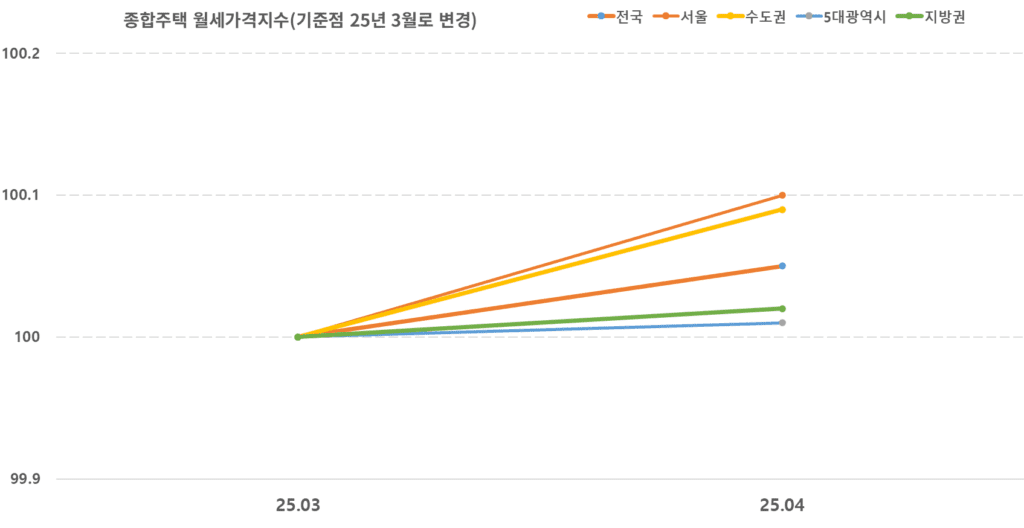
The monthly rent price index rose nationwide by 0.051 tp3t, showing a slight decrease from the previous month. Seoul (0.101 tp3t) maintained its upward trend due to the deterioration of jeonse loan conditions, leading to the conversion of jeonse into monthly rent. Among the Seoul Metropolitan Area (0.091 tp3t), Incheon saw a decline centered around Yeonsu-gu, but a rise centered around Jung, Gyeyang, and Namdong-gu. In Gyeonggi Province, prices fell centered around Gwangmyeong and Icheon, but rose centered around Gwacheon, Seongnam, Sujeong, and Bucheon's Sosa-gu. Among the five major metropolitan cities, Ulsan rose, but Daejeon fell, shifting the overall increase from a flat trend. Among other regional areas, Sejong saw an increase, but Jeju continued to decline. Furthermore, South Chungcheong, North Jeolla, and South Jeolla Provinces saw declines, leading to a narrowing of the increase in eight provinces.
With the re-designation of the land transaction permit system on March 24, transactions in high-end districts such as Gangnam, Seocho, Songpa, and Yongsan were halted, and the nationwide increase in sales prices appeared to have slowed down, but monthly rent prices showed a similar level of fluctuation as the average month.