- Fitout, TI, Rent-Free, and NOC

Unlike the housing market, the commercial real estate (office, retail) leasing market has its own unique terminology and practices. In particular, a clear understanding of "fit-out" and "rent-free," which frequently appear during rent negotiations, as well as the concept of "NOC," which integrates these terms to calculate costs, is the first step toward making sound decisions.
We've compiled key concepts and practical tips to help you make informed decisions about complex lease terms and costs, including the precise meanings of "fit-out" and "rent-free," which may seem similar but are clearly distinct in practice, and the concept of "NOC."
Fit-out: Consideration for the physical construction period
 Fit-out refers to a 'construction grace period' given to tenants to carry out necessary interior construction work in the leased space before commencing actual work or business after moving in.
Offices and commercial properties are often not available for immediate use immediately after signing a lease. This is because physical construction, such as installing partitions, finishing the floor, and installing electrical and communication wiring, is required depending on the tenant's needs and intended use. It's customary for landlords to waive rent during this period for the convenience of the tenant.
TI(Tenant Improvement): Support for interior design costs
 While fitout provides "time" for construction, "Tenant Improvement (TI)" provides the necessary "funding" for the project. Simply put, this is a method where landlords support tenants by either providing cash support for a portion (or all) of the tenant's interior renovation costs or performing the work themselves.
Typically, contracts are made with a fixed amount per pyeong (e.g., 1 million won per pyeong). This provides a powerful incentive for tenants, significantly reducing initial investment costs. Therefore, it's a useful tool for landlords seeking to actively attract tenants.
"TI" is a landlord strategy for attracting tenants, distinct from rent-free plans. When landlords use the funds provided to improve a building's internal facilities, such as floors, ceilings, and lighting, even after the tenant moves out, these improvements remain, enhancing the building's physical value. Thus, TI can be considered a sophisticated strategy that simultaneously aims to attract tenants and enhance asset value, depending on how it's utilized.
Rent-Free: Financial Incentives and Asset Value
 Rent-free is during the agreed contract period. 'Providing rent free of charge for a certain period of time'While fit-out is dictated by the physical needs of construction, rent-free is more of a "price discount policy" to attract tenants. It's usually specified in contracts in various forms and expressions, such as "one month per year (12+1)" or "the first three months are exempt."
So, what's the main reason landlords offer rent-free periods instead of reducing nominal rents? It's "asset value preservation." Since the sale price of a building is primarily based on rental yield, this can be understood as a strategy to preserve the building's appraised value by maintaining the unit rent price stipulated in the contract.
※Practical Note: Rent is typically waived during fit-out and rent-free periods, but management fees and actual expenses (such as electricity and water) are typically charged. Fit-outs typically last between two weeks and a month, depending on the area and difficulty of the construction. However, please note that longer periods may be negotiated depending on the circumstances.
NOC(Total cost per exclusive area): The most objective comparison standard
 When comparing buildings with different lease terms, it's difficult to determine superiority solely based on "rent per square foot." This is because each building has different occupancy rates (space efficiency), management fees, and rent-free terms.
The concept used at this time is NOC(Net Occupancy Cost)This is the tenant's exclusive area of 3.3058㎡(It refers to the 'actual total cost' spent to use 1 pyeong.
[[Practical Case] NOC Comparison Simulation
※ In the strict accounting sense, NOC should be calculated by including the opportunity cost of operating income (interest) on the deposit. However, for the convenience and intuitive understanding of readers, this article will simplify the calculation by focusing on the actual monthly "cash flow."
Let's assume a company that needs 330.58㎡ (100 pyeong) of exclusive use area is considering two buildings (A and B).
Building conditions
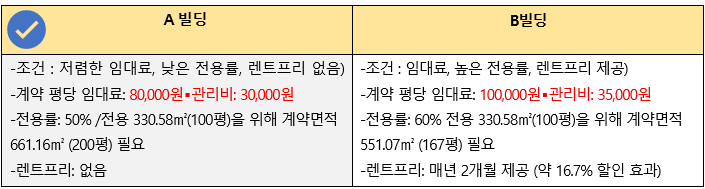
On the surface, the per-unit rent for Building A (80,000 won) appears cheaper than for Building B (100,000 won). However, when converted to a NOC (Non-Occupational Cost), which reflects the exclusive use ratio and rent-free period, the results are different.
NOC calculation

Converting this to the NOC standard and calculating it, we see that Building B, which appears to have a higher rent on the surface, is actually about 23,000 won cheaper per pyeong. This translates to a cost difference of over 27 million won per year for a 100-pyeong unit.
These simulations clearly demonstrate that "exclusive use" and "rent-free" have a greater impact on real costs than the nominal monthly rent.
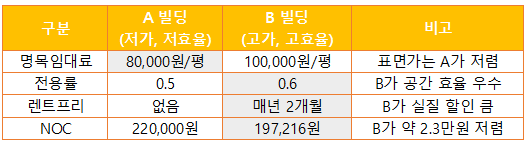
 The visible "unit rent" in commercial real estate contracts can be a momentary illusion. Calculating the NOC, which reflects space efficiency based on occupancy ratio and the rent-free period, is a very useful method for tenants, enabling cost savings and investors, enabling accurate profit analysis.