2025.7 Comprehensive Housing Price Index
Note
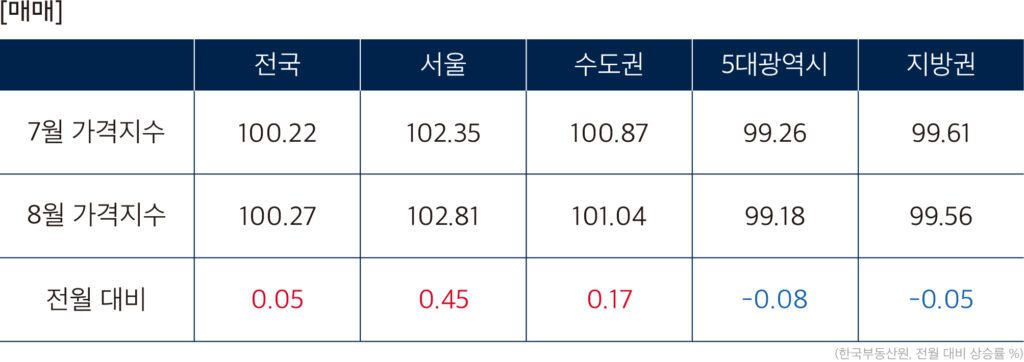
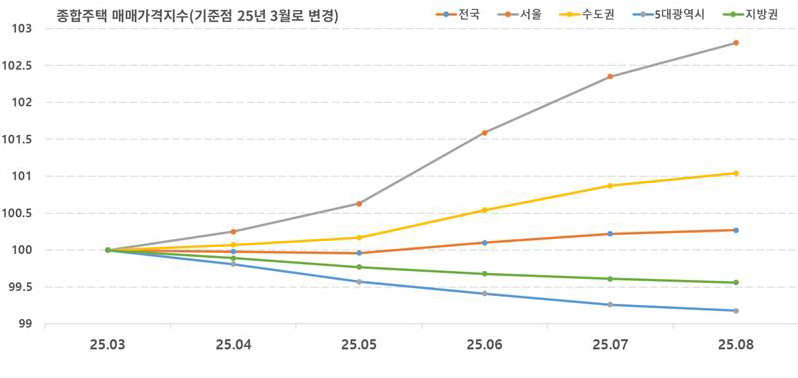
The national housing price index rose 0.051 TP3T in August compared to the previous month, maintaining its upward trend for the fourth consecutive month. Seoul's price index rose 0.451 TP3T, significantly exceeding the national average. The increase was particularly notable in Gangnam, where redevelopment expectations are high, and in areas favored by subway stations. Songpa-gu (+1.201 TP3T) saw a sharp rise, centered around redevelopment complexes in Jamsil and Sincheon-dong. Yongsan-gu (+1.061 TP3T), Seongdong-gu (+0.961 TP3T), Mapo-gu (+0.591 TP3T), and Gangnam-gu (+0.541 TP3T) also saw strong performances, particularly in complexes with excellent school districts and residential environments. Conversely, gains in the outskirts of Gangbuk were limited.
The Seoul metropolitan area rose by 0.171 TP3T, a smaller increase than last month (0.331 TP3T), and a polarization trend was evident. In Gyeonggi Province, Bundang-gu (+1.081 TP3T), Gwacheon-si (+0.851 TP3T), and Anyang-dong-gu (+0.801 TP3T) saw sharp increases, centered around large, expensive apartment complexes. Meanwhile, some less-popular areas, such as Goyang-si Ilsanseo-gu (-0.351 TP3T) and Pyeongtaek-si (-0.651 TP3T), saw declines. Incheon recorded -0.081 TP3T, with declines primarily in small and medium-sized apartment complexes in Seo-gu, Yeonsu-gu, and Gyeyang-gu.
The local market continued its downward trend, reaching -0.051 TP3T. Major metropolitan cities such as Daegu (-0.191 TP3T), Jeju (-0.141 TP3T), Daejeon (-0.121 TP3T), and Gwangju (-0.071 TP3T) saw significant declines due to the burden of new housing and sluggish transactions. Conversely, Ulsan (+0.091 TP3T), Sejong (+0.151 TP3T), and North Jeolla Province (+0.071 TP3T) saw slight increases, centered around complexes with favorable living conditions.
Note
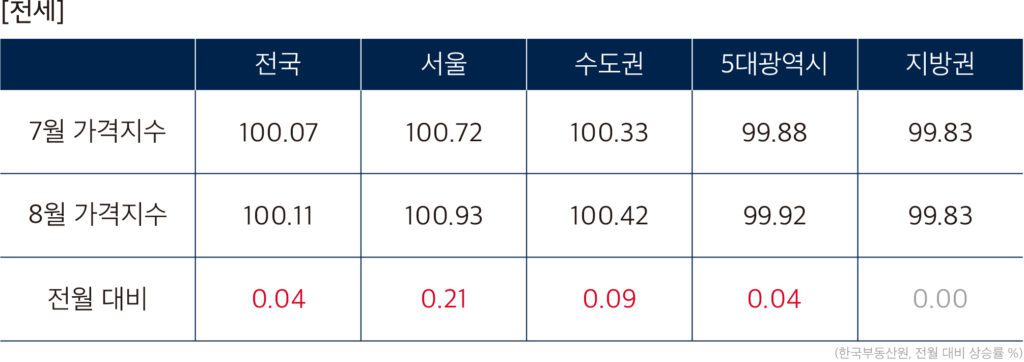
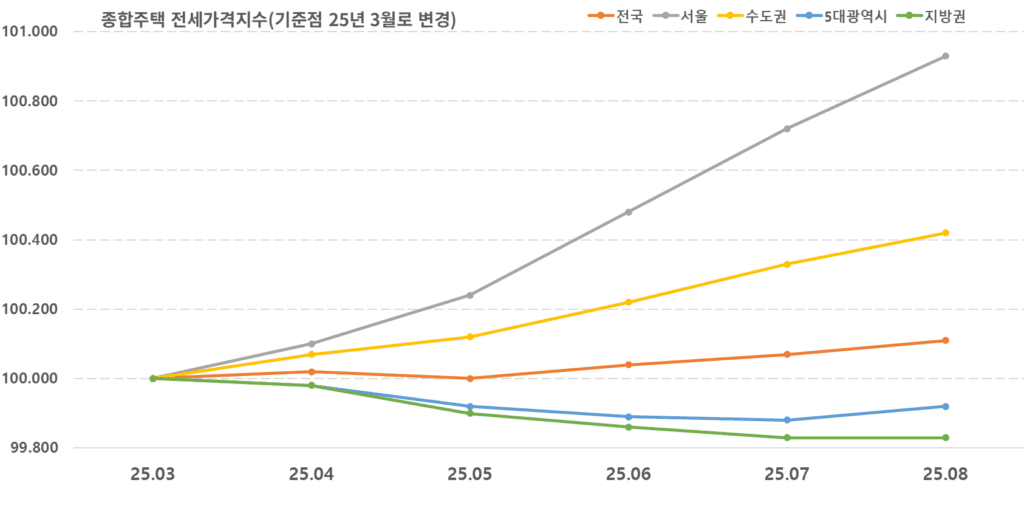
The national jeonse price index rose 0.041 TP3T in August, continuing a slight upward trend for the third consecutive month. Seoul saw a 0.211 TP3T increase, driven by demand in popular residential areas. Areas with fixed demand, such as those near subway stations, new construction, and school districts, drove the increase, including Songpa-gu (+0.721 TP3T), Gangdong-gu (+0.371 TP3T), Yongsan-gu (+0.301 TP3T), Yeongdeungpo-gu (+0.291 TP3T), and Gwangjin-gu (+0.221 TP3T). Conversely, Seocho-gu (-0.121 TP3T) saw a decline in complexes primarily built on existing properties.
The Seoul metropolitan area saw a 0.091 TP3T increase, but there were clear regional differences. Gyeonggi Province saw an overall increase of 0.051 TP3T, with large complexes near subway stations, such as Hanam (+0.761 TP3T), Gwacheon (+0.711 TP3T), and Anyang Dongan (+0.591 TP3T), showing strength. However, areas with high demand for housing, such as Ilsanseo-gu in Goyang (-0.391 TP3T), Pyeongtaek (-0.351 TP3T), and Seo-gu and Namdong-gu in Incheon (-0.171 TP3T), saw declines.
Local markets remained flat at 0.001 TP3T, but regional trends diverged. Ulsan (+0.201 TP3T), Sejong (+0.311 TP3T), and North Chungcheong Province (+0.011 TP3T) showed recovery, centered around complexes with favorable living conditions. Meanwhile, Daejeon (-0.131 TP3T), Daegu (-0.061 TP3T), and Jeju Island (-0.151 TP3T) continued to weaken.


Note
The national monthly rent price index rose by 0.111 TP3T in August, expanding from the previous month's 0.081 TP3T. All regions showed stable or higher trends, recording 0.251 TP3T in Seoul, 0.151 TP3T in the Seoul Capital Area, and 0.061 TP3T in other regions. In Seoul, demand is steadily increasing, driven by a preference for monthly rent over jeonse (long-term deposit). Songpa-gu (+0.641 TP3T), Yongsan-gu (+0.471 TP3T), Yeongdeungpo-gu (+0.411 TP3T), and Seongdong-gu (+0.341 TP3T) showed a notable upward trend, particularly in small apartments with favorable living conditions.
In the metropolitan area, prices rose, particularly in areas with a strong preference for high-priced monthly rents. In Gyeonggi Province, Gwacheon (+0.401 TP3T), Anyang Dongan (+0.251 TP3T), and Hanam (+0.191 TP3T), there was active rent conversion for officetels and small and medium-sized apartments. In regional areas, Ulsan (+0.291 TP3T), North Chungcheong Province (+0.101 TP3T), and Busan (+0.091 TP3T) showed increases, while Jeju (-0.151 TP3T), Daegu (-0.071 TP3T), and Daejeon (-0.071 TP3T) saw declines.
The main reason is that the demand for monthly rent conversion, especially among young people and single-person households, is structurally expanding due to regulations on jeonse loans and unstable jeonse market conditions.
The August housing market exhibited a distinct polarization, with rising prices in popular areas of Seoul and the greater Seoul area, and weakness in most regions. In Seoul, recovery continued across all categories, including sales, jeonse (long-term lease), and monthly rent, centered on redevelopment expectations, areas with favorable residential conditions, and complexes near subway stations. While the greater Seoul area saw a limited influx of buyers, particularly in high-priced, large-scale complexes, a wait-and-see approach prevailed in less desirable areas. Conversely, most metropolitan cities, including Daegu, Daejeon, Gwangju, and Jeju, continued to decline due to weakening structural demand and sluggish transaction volume. The recovery was limited to localized, small rebounds in some regions.
The jeonse market continues to be concentrated in preferred areas, particularly in Seoul and the greater Seoul area, while regional areas remain vulnerable due to the burden of oversupply and sluggish transactions. Furthermore, the monthly rental market is experiencing a steady influx of demand due to jeonse instability and loan regulations. In particular, a preference for monthly rentals is becoming increasingly entrenched, particularly among young people and single-person households.
Overall, the August market showed a widening regional temperature gap depending on supply and demand conditions, housing conditions, and investment sentiment. It remains to be seen whether the recovery centered around Seoul will translate into a nationwide rebound.